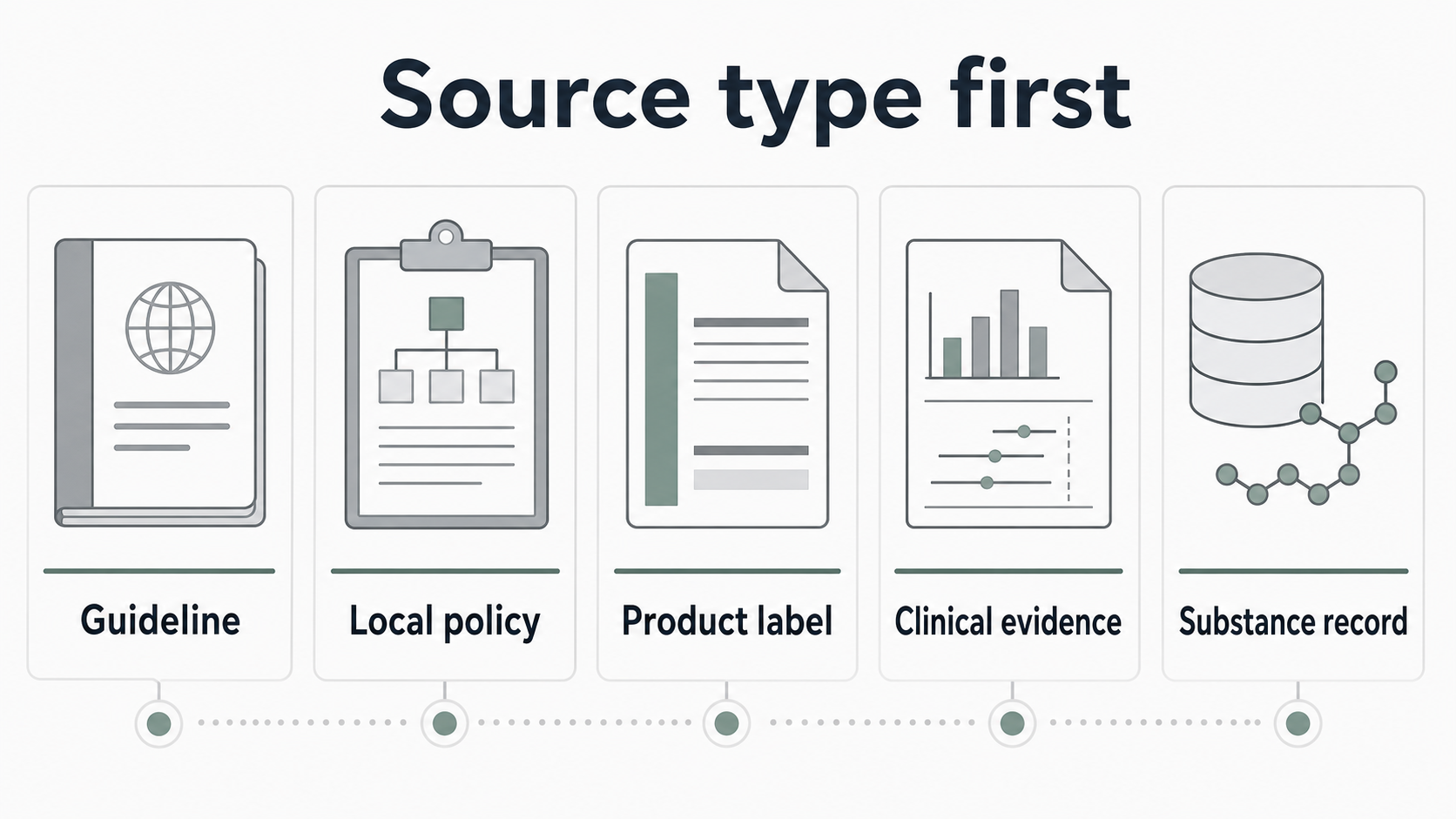
When an octenidine-related protocol, label, regulator record, or evidence review lands on your desk, the useful first move is to identify what kind of source it is.
This article helps healthcare readers keep guideline language, local policy, product-label wording, clinical evidence, and substance identity records in their proper lanes, so a source summary stays useful for review without drifting into bedside instruction.
Quick Position
Before asking what a document says about octenidine, identify what kind of source it is.
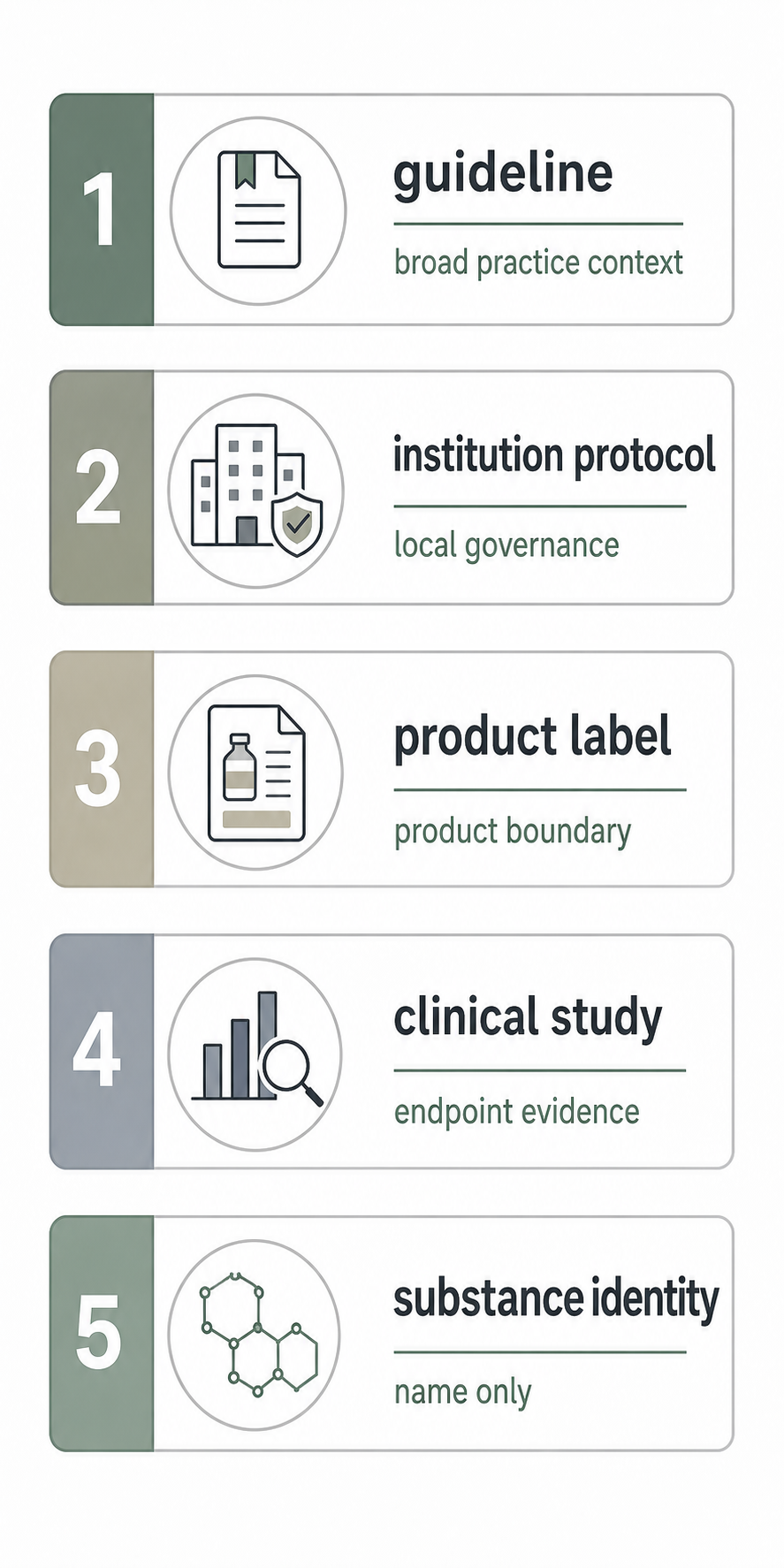
A guideline describes evidence-informed practice context. Local protocols define a facility’s own process, while product labels set product-specific boundaries. Clinical studies support a studied endpoint, and substance records confirm identity and synonyms. None of those document types can do every job.
This distinction matters because octenidine appears in different forms: octenidine dihydrochloride, octenidine hydrochloride, octenidine-containing wash products, combination products with phenoxyethanol, and finished products authorized or marketed in specific jurisdictions. A source that names one of those categories should not be stretched to another category without a second check.
Start With The Document Type
When a protocol, policy, or article mentions octenidine, identify the document type before summarizing the claim.
- Guideline: What population, setting, and clinical question does the guideline cover?
- Local protocol: Which facility, staff role, governance process, and implementation environment does it assume?
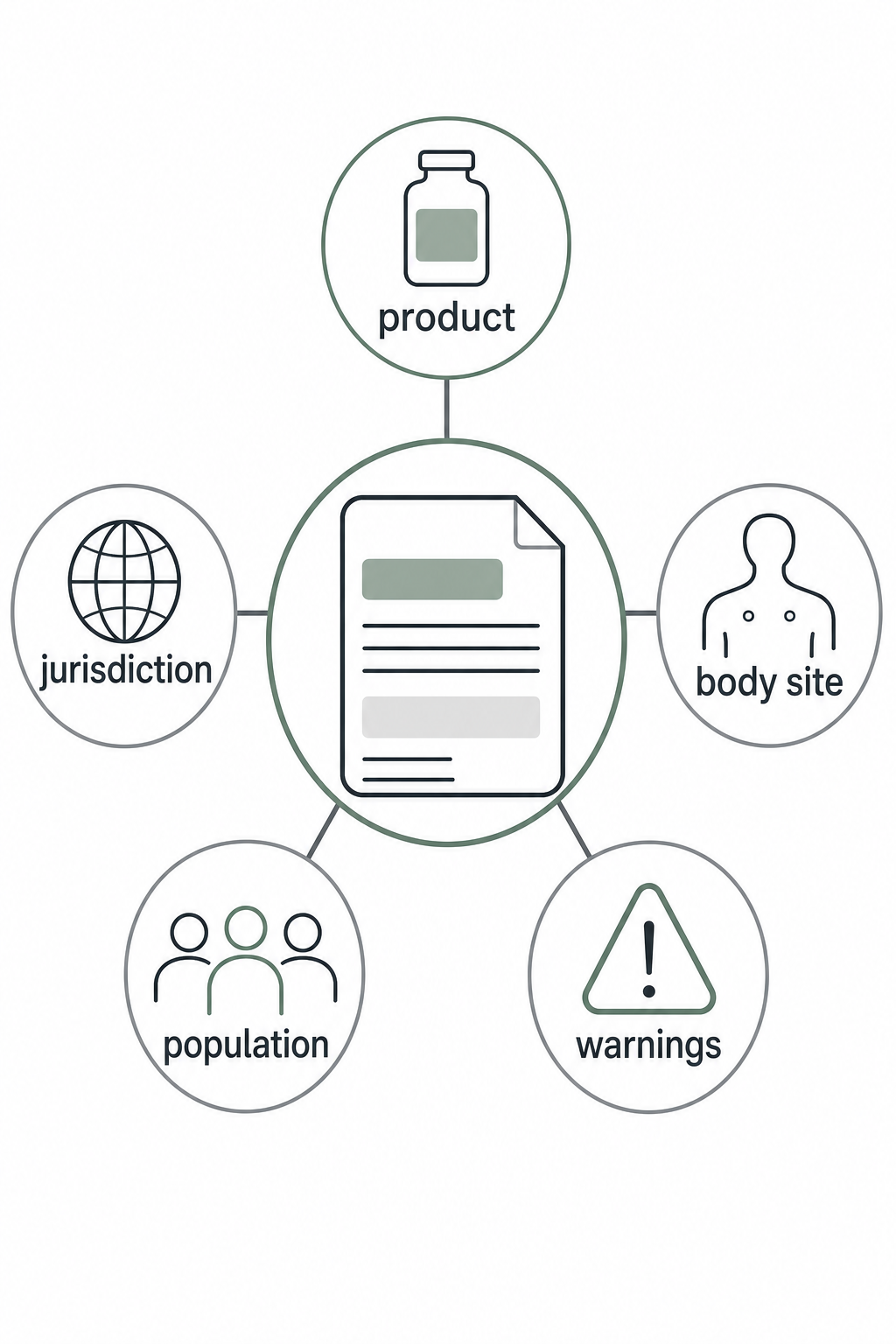
- Product label or regulator record: Which product, jurisdiction, route or body site, warning language, and version does it describe?
- Evidence review or primary study: Which formulation, comparator, population, endpoint, and follow-up window were studied?
- Substance identity record: Which name, synonym, formula, or registry identifier is confirmed?
The same phrase can have different meaning depending on the source. “Use in wound disinfection” in a product record is not evidence that a product improves wound healing. A trial endpoint differs from a label indication, and a label warning differs from a comparative effectiveness result. Even a local protocol does not prove that the same practice is appropriate elsewhere.
Read Guidelines As Practice Context
Guidelines are strongest when the article stays inside the guideline’s own scope. CDC catheter guidance names chlorhexidine-containing approaches in several catheter-related recommendations, including daily skin cleansing and central venous catheter insertion skin antisepsis. CDC’s chlorhexidine-impregnated dressing update separates adult recommendations, pediatric uncertainty, premature-neonate cautions, FDA-cleared label context, and which earlier recommendations it supersedes.
CDC’s Staphylococcus aureus bloodstream infection prevention page is also scope-specific. It is aimed at acute-care facilities and says the listed interventions are not intended for outbreak response and are intended for adult inpatient units. That page names chlorhexidine in decolonization and pathogen-reduction strategies, but it does not create an octenidine substitution pathway.
NICE surgical-site guidance shows why label checking matters even when a guideline names an antiseptic class. NICE lists options for surgical-site skin preparation, warns about risks of skin antiseptics in babies, and states that some products may not be licensed for surgical-site antiseptic skin preparation. WHO’s surgical-site infection guideline page states that its updated guidelines are valid for any country and suitable for local adaptation, which is still not the same as a local product label or facility policy.
FDA’s health care antiseptics Q&A is useful as U.S. regulatory-category context. It describes health care antiseptics as products used by healthcare professionals in hospital and other healthcare situations and points healthcare personnel back to workplace infection control guidelines while FDA rulemaking questions are addressed.
When writing about these sources, preserve the guideline name, population, setting, jurisdiction, and recommendation scope. Do not convert a guideline mention into a universal rule for octenidine-containing products.
Read Product Records As Boundaries
Product labels and regulator records answer product-specific questions. They can identify active ingredients, concentration, product category, route, warnings, and jurisdiction-specific authorization or listing status. They should not be used as independent proof of comparative clinical benefit.
DailyMed’s ChloraPrep One-Step label is a U.S. product-label source for a chlorhexidine gluconate and isopropyl alcohol product. It identifies the product type, topical route, active ingredients, and label warnings. That information is product-specific and should not be generalized to every chlorhexidine product or to octenidine.
The Australian TGA ARTG record for an Octenisept product identifies an octenidine hydrochloride and phenoxyethanol solution bottle, ARTG ID 338418, with medicine registration information and listed ingredients. That record is useful for Australian product and ingredient context. It does not establish U.S. authorization, broader octenidine interchangeability, or clinical superiority.
FDA GSRS confirms that octenidine hydrochloride is the preferred substance name for UNII U84956NU4B and lists octenidine dihydrochloride as a synonym. The same record states that UNII availability does not imply regulatory review or approval. Use it for identity and synonym handling, not for protocol approval.
Preserve High-Risk Boundaries
Protocol interpretation becomes higher risk when a source touches infants, premature neonates, pregnancy, breastfeeding, mucosa, eyes, ears, deep wounds, burns, surgical fields, invasive devices, catheter sites, allergy history, or immunocompromised patients.
Do not fill gaps in those areas from general octenidine summaries. If the source does not state the exact population, body site, product, and warning context, keep the public claim narrow or leave it out.
Swissmedic’s report on Octenisept and incorrect use to irrigate deep wounds is a useful safety-boundary example. It describes a medication-error context involving an octenidine and phenoxyethanol product and tissue complications after deep wound irrigation. That source should not be turned into broad panic language or a product-wide safety conclusion, but it does show why deep-wound, pressure, injection, lavage, and off-label-use wording needs exact source support.
Separate Protocol Language From Evidence Language
A protocol usually decides what a facility does. Evidence usually describes what a study or review found. A label describes product boundaries. These should remain separate in article wording.
Use wording like:
- The guideline names this antiseptic in this setting.
- The product record lists these active ingredients in this jurisdiction.
- The review found mixed or limited evidence for this clinical context.
- The study evaluated this product against this comparator for this endpoint.
- This source does not establish a protocol, substitution, or patient-specific recommendation.
Avoid wording like:
- The protocol proves the product works.
- The label means the product is appropriate for all similar uses.
- The study result should be implemented directly.
- Octenidine can replace a chlorhexidine step.
- This source confirms safety for high-risk sites or populations.
A Study Is Not A Bedside Instruction
The 2023 octenidine clinical evidence review is useful because it keeps clinical contexts separate: Staphylococcus aureus carriage or transmission, surgical-site infection prevention, and ICU- or catheter-related bloodstream and insertion-site infection outcomes. It also reports important limitations, including heterogeneity, bundled interventions, and a need for more comparative studies.
Those limitations should travel with any protocol-facing summary. A review can identify evidence gaps. It cannot specify how a hospital should write a protocol, which product should be substituted, or whether a particular patient should receive a product.
The same rule applies to local protocols found online. A facility protocol may be a legitimate local document, but it reflects that facility’s products, governance, training, population, risk tolerance, and jurisdiction. It should not be copied into public educational content as if it were a general healthcare standard.
How To Summarize A Protocol Source
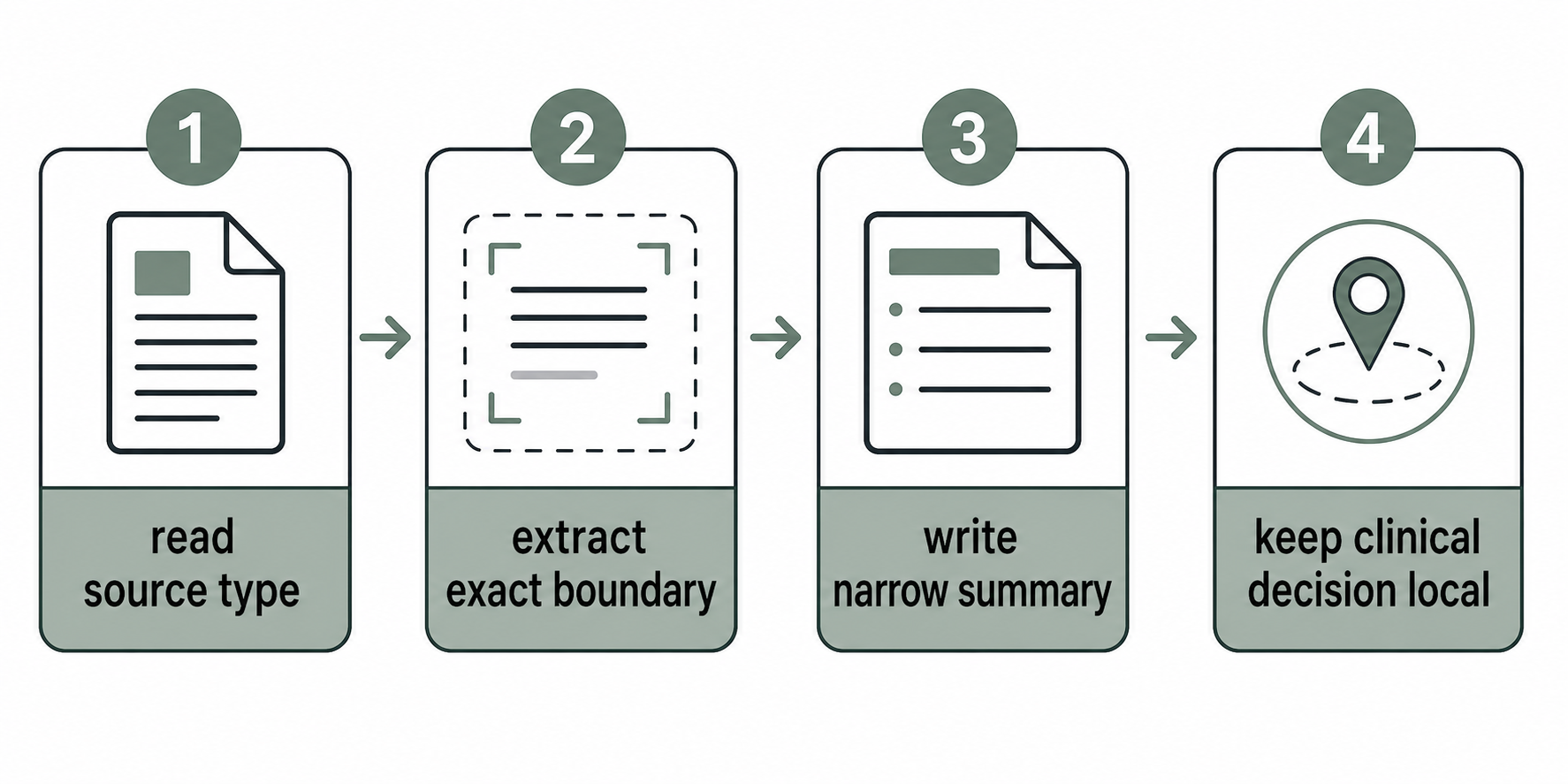
A responsible public summary should be short, exact, and bounded:
- Name the document type and jurisdiction.
- Name the product or formulation if the source does.
- Name the setting and body site only if the source does.
- Name warnings, contraindication language, and high-risk exclusions without softening them.
- State when the source does not answer clinical effectiveness, substitution, authorization, or patient-specific questions.
For example, “An Australian TGA record lists an Octenisept product with octenidine hydrochloride and phenoxyethanol” stays inside the source; “Octenidine is approved for wound care everywhere” overreaches it.
What This Article Does Not Support
This article does not support:
- Writing, changing, or implementing a clinical protocol.
- Advising a product, route, body site, concentration, contact time, frequency, duration, substitution, or sequence.
- Applying one institution’s protocol to another institution.
- Using an identity record as evidence of authorization or clinical benefit.
- Using a product label as evidence of superiority over another antiseptic.
- Summarizing high-risk populations or body sites without exact label and protocol review.
Sources And Review
Last reviewed: 2026-05-07. References used here include CDC guidance, NICE and WHO surgical-site guidance, U.S. and Australian product or regulator records, an FDA substance identity record, Swissmedic safety reporting, and an octenidine clinical evidence review. Editorial review is not medical advice, regulatory advice, or a clinical recommendation.