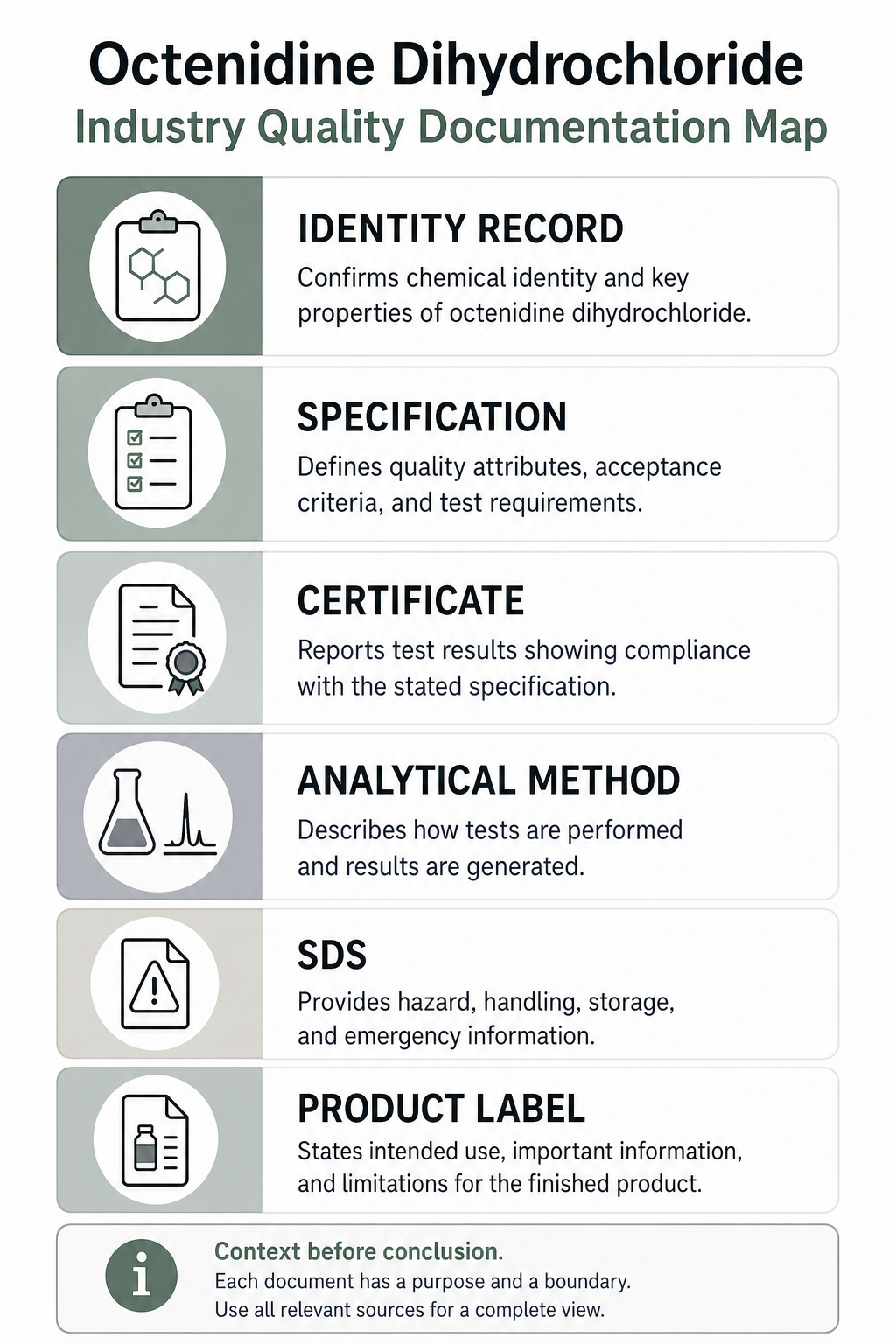
This article explains how to read quality and supplier documentation about octenidine dihydrochloride without turning document fragments into vendor, procurement, approval, or batch-release claims.
It is not legal advice, regulatory advice, procurement guidance, import guidance, supplier qualification, GMP assessment, batch-release guidance, laboratory procedure, or a quality-system procedure. It does not recommend products, vendors, laboratories, methods, certificates, or specifications.
Quick Position
Start with identity. FDA GSRS lists OCTENIDINE HYDROCHLORIDE with UNII U84956NU4B and synonym mappings that include OCTENIDINE DIHYDROCHLORIDE, while noting that UNII availability does not imply regulatory review or approval.
PubChem CID 51166 records octenidine hydrochloride with molecular formula C36H64Cl2N4, molecular weight 623.8, and InChIKey SMGTYJPMKXNQFY-UHFFFAOYSA-N. ECHA substance information associates octenidine dihydrochloride with EC/List number 274-861-8 and CAS number 70775-75-6.
Those identity records can help verify names, salt-form language, identifiers, and synonym clusters. They do not prove purity, assay, impurity profile, batch conformity, compendial status, supplier qualification, GMP status, regulatory approval, or finished-product quality.
Documents Answer Different Questions
Quality and supplier documentation often includes several document types. Each one has a narrower role than it may appear to have at first glance.
- An identity record covers names, identifiers, formulae, and synonym checks.
- A specification lists the tests, analytical procedures, and acceptance criteria written into that specification.
- A certificate of analysis reports specific results for a named batch or lot, with the issuer, method references, date, and acceptance criteria shown on the certificate.
- A CEP covers only the scope described on that CEP and the EDQM procedure that produced it; it is not a batch-release certificate.
- An analytical-method paper documents the analyte, matrix, method, validation scope, and study results inside that paper.
- An SDS handles hazard communication for the exact substance or mixture and document version.
- A product label states product-specific composition, warnings, intended use, storage, and revision-date information inside its jurisdiction and document scope.
No single document type should be treated as a complete supplier-quality answer.
What A Specification Covers
FDA’s publication of ICH Q6A describes specifications for new chemical drug substances and drug products as test procedures and acceptance criteria. The Q6A text defines a specification as a list of tests, references to analytical procedures, and appropriate acceptance criteria such as numerical limits, ranges, or other criteria for the tests described.
That concept is useful for reading octenidine documentation because a specification is not the same as an audit, a supplier ranking, a market authorization, or a certificate that every future batch conforms. It states what is to be tested and what criteria apply within that document’s scope.
If a document says “purity,” “assay,” “related substances,” “water,” “residual solvent,” “microbial limit,” or another quality term, the reader still needs to know the method, acceptance criterion, sample or batch, result, unit, issuer, date, and whether the document is current and applicable to the material being discussed. This article does not set those criteria and does not judge any supplier document.
Analytical Verification Is Method-Specific
ICH Q2(R2), as published by FDA, provides a general framework for analytical-procedure validation. FDA’s Q14 page describes harmonized guidance on scientific approaches for analytical-procedure development. These sources are useful for terminology around analytical validation and method development, but they do not validate a particular octenidine certificate, batch, supplier, or finished product by themselves.
A 2026 RSC Advances paper developed an RP-HPLC method for simultaneous determination of octenidine dihydrochloride and phenoxyethanol in specified antiseptic spray and gel matrices. The paper reports the named analytes, matrix context, chromatographic approach, calibration ranges, validation parameters, and application to the studied products. It is a method-specific analytical source. It should not be cited as proof that another method, product, batch, supplier, formulation, or certificate is valid.
Analytical statements should therefore be narrow:
- “This paper studied simultaneous RP-HPLC determination of octenidine dihydrochloride and phenoxyethanol in the stated spray and gel matrices.”
- “This certificate reports an assay result for the named batch using the method reference shown on the certificate.”
- “This identity record lists the official synonym and identifier used to match the material name.”
They should not become:
- “The supplier is qualified.”
- “The material is GMP grade.”
- “The product is approved.”
- “The batch is suitable for clinical use.”
- “All octenidine products are analytically equivalent.”
Certificates Need Their Own Boundaries
Certificate language can look authoritative even when the certificate’s scope is narrow. A certificate of analysis, a certificate of suitability, a reference-standard certificate, and a safety data sheet do not answer the same question.
EDQM explains that CEP stands for Certification of suitability to the monographs of the European Pharmacopoeia. EDQM’s “How to read a CEP” guidance states that a CEP covering chemical purity and microbiological quality certifies, based on specific data supplied by the manufacturer, that the quality of a substance can be suitably controlled by the Ph. Eur. monograph. The same EDQM guidance states that a CEP does not certify that a specific batch or batches comply with the monograph and additional tests, is not equivalent to a batch-release certificate, and is not a GMP certificate.
USP’s Reference Standards FAQ gives another certificate boundary. USP says it does not provide certificates of analysis for USP Reference Standards and instead provides USP Certificates for most reference standards, with information such as label text, molecular information, typical chromatograms in limited cases, and additional use or handling information that may not be on the label. That is reference-standard documentation, not a supplier COA for an octenidine material.
For any certificate, the conservative writing question is: what exactly does this certificate say, for which material, batch or standard, issuer, method, date, and scope?
SDSs Are Hazard Documents
OSHA Appendix D to 29 CFR 1910.1200 gives the 16-section SDS format for U.S. hazard communication. An SDS can support source-backed statements about hazards, composition, handling, storage, exposure controls, transport context, and revision information for the exact material or mixture described in that SDS.
An SDS should not be used to prove clinical safety, body-site suitability, product authorization, product effectiveness, formulation compatibility, supplier qualification, GMP status, compendial compliance, batch release, or product interchangeability. Those claims require other documents and often a different review process.
Reading Supplier Pages
A supplier catalog page, availability note, price listing, marketing phrase, shipping statement, or downloadable certificate should not be treated as independent proof of identity, purity, regulatory status, clinical value, market authorization, or supplier quality.
If a supplier document is used at all, the copy should stay inside the document:
- The material name as printed.
- The issuer and date.
- The batch or lot number if present.
- The method or standard cited.
- The reported result and unit.
- The acceptance criterion if present.
- The revision or validity status if stated.
- Any limitation or mismatch compared with official identity records, product labels, or regulator pages.
Out-of-scope claims include vendor rankings, procurement suitability, price comparisons, importability, GMP conclusions, audit conclusions, compendial conclusions without exact source documents, batch release, clinical safety, clinical effectiveness, use instructions, product approval, and interchangeability.
Sources And Review
This article was editorially reviewed for source traceability on 2026-05-07. Key source categories included FDA GSRS, PubChem, and ECHA for identity; FDA and ICH quality guidance for specifications and analytical-procedure terminology; an RSC Advances analytical-method paper for a method-specific octenidine example; EDQM CEP guidance and FAQ material for certificate boundaries; USP Reference Standards FAQs for reference-standard certificate terminology; and OSHA Appendix D for SDS format context.
Editorial review is not medical advice, regulatory advice, legal advice, procurement advice, import advice, supplier qualification, GMP assessment, batch-release review, quality-system advice, or a clinical recommendation.