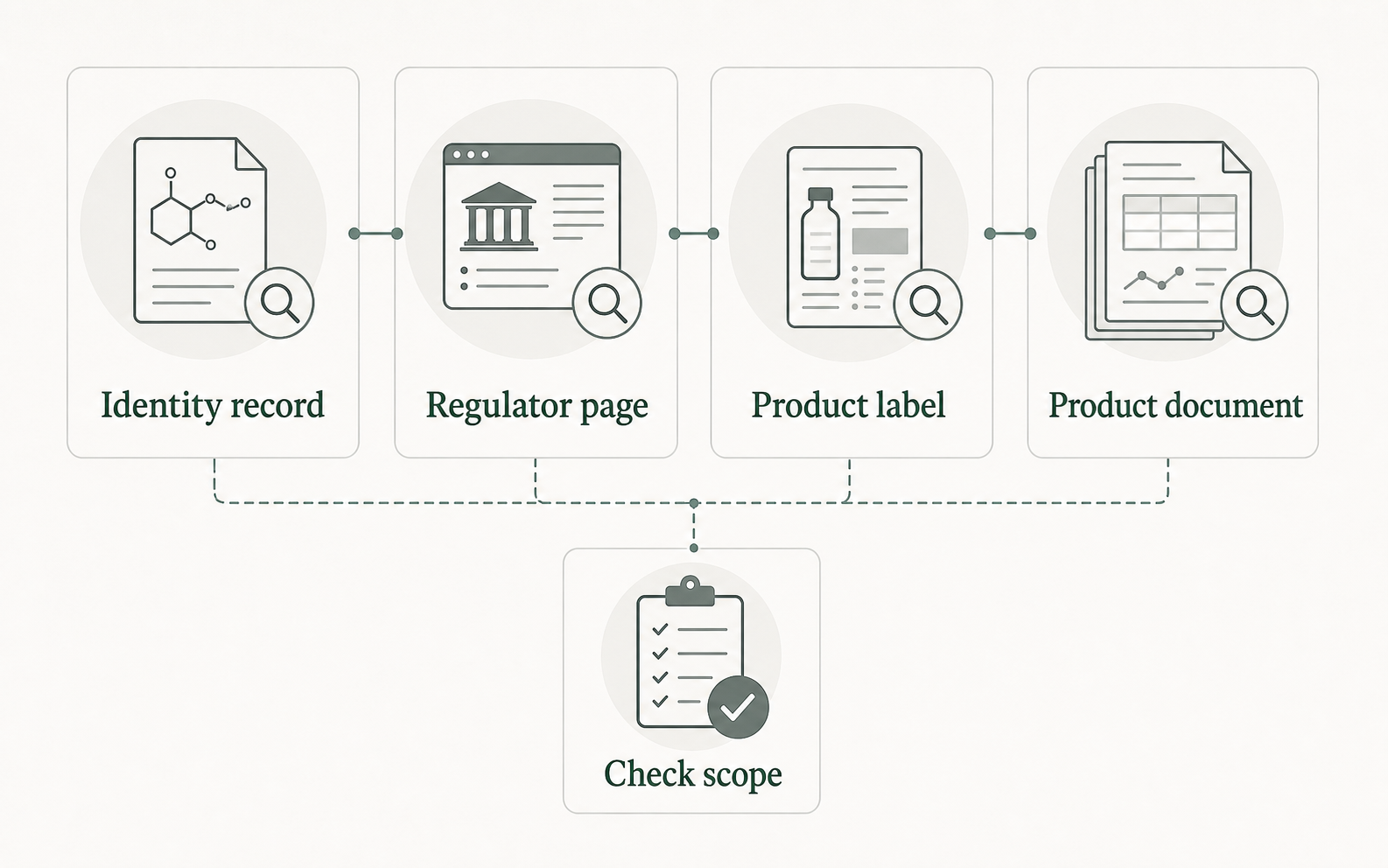
This industry source-navigation page explains how to match a statement about octenidine dihydrochloride to the kind of document that can support it.
It is not regulatory advice, legal advice, procurement guidance, import guidance, supplier qualification, GMP assessment, product approval mapping, or a quality-system procedure. It also does not recommend products, vendors, formulations, or substitutions.
Source Categories
A useful document review starts by asking what kind of statement is being made. A chemical identity statement, a jurisdiction-specific regulatory statement, a finished-product label statement, and a supplier-document statement need different sources.
Official substance records are strongest for names and identifiers. FDA GSRS lists OCTENIDINE HYDROCHLORIDE with UNII U84956NU4B, formula C36H62N4.2ClH, and synonym mappings that include OCTENIDINE DIHYDROCHLORIDE. The same GSRS page states that UNII availability is based on scientific identity characteristics and does not imply regulatory review or approval.
PubChem CID 51166 records Octenidine Hydrochloride with molecular formula C36H64Cl2N4, molecular weight 623.8, InChIKey SMGTYJPMKXNQFY-UHFFFAOYSA-N, and a parent compound relationship to octenidine, CID 51167. PubChem is useful for cross-checking identifier clusters, but high-risk regulatory or product claims still belong with the original regulator, label, or product document.
ECHA’s substance information for octenidine dihydrochloride associates the record with EC/List number 274-861-8 and CAS number 70775-75-6. ECHA registration dossier pages can provide more detailed dossier-derived material, but ECHA notes that registered-substance information has not necessarily been reviewed or verified by the Agency or another authority and may change. That is a source boundary, not a reason to treat the dossier as supplier qualification or compliance proof.
Jurisdiction-Specific Pages
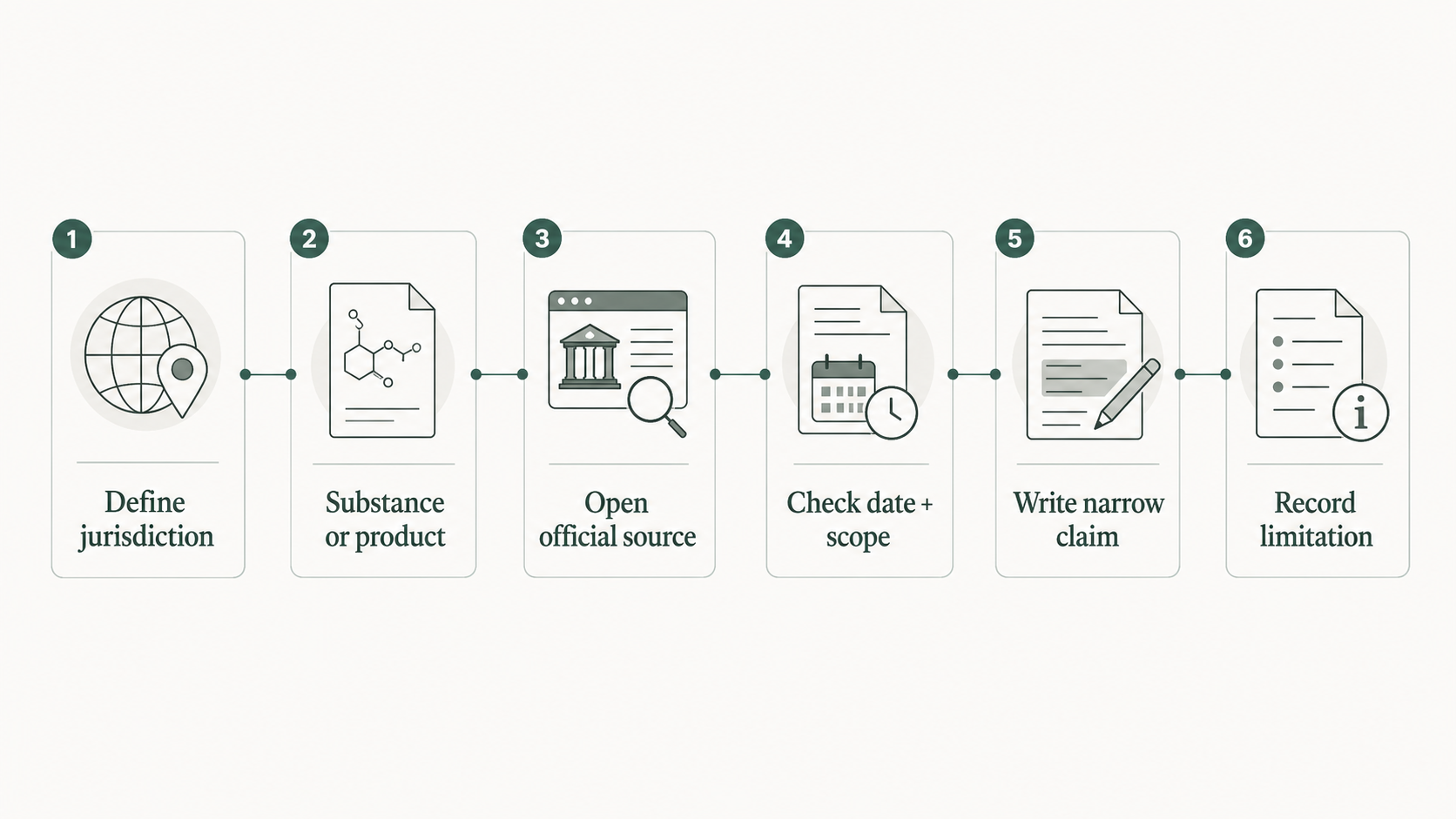
Start a regulatory statement by defining the jurisdiction. Then define whether the statement concerns a substance, salt form, active moiety, finished product, product class, route, species, body site, or use context. If the source does not answer that exact question, keep the gap visible.
The EMA octenidine dihydrochloride maximum-residue-limit page is an EU veterinary regulatory source. Its page and linked European public MRL assessment report concern maximum residue limits for octenidine dihydrochloride in all mammalian food-producing species. The EPMAR describes a veterinary context and a cutaneous-use dossier; it should not be rewritten as a human antiseptic authorization, a global approval claim, a finished-product interchangeability statement, or a procurement signal.
For U.S. source navigation, FDA GSRS is an identity source, not an approval source. FDA label resources and DailyMed are product-labeling resources for submitted or FDA-related labeling records, but a search result, listing, or ingredient match is not by itself proof that a specific octenidine-containing product is approved, currently marketed, interchangeable, or appropriate for any intended use.
Product Documents
Finished-product documents can differ by country, formulation, concentration, co-ingredients, intended use, body site, warnings, directions, and revision date. Industry-facing copy should keep those distinctions visible.
FDA’s Drugs@FDA glossary describes the approved label as the official description of a drug product, including use, population, adverse-event, safety, and patient-information content for that product. The label concept is tied to that specific product: it does not make every item with a similar active-ingredient name equivalent, and it does not transfer across jurisdictions without a source that says so.
DailyMed and the FDA Online Label Repository are useful label-discovery and label-review tools, but they are still document sources. A label record can support what that record says about that product and revision. It cannot support a claim that a different formulation, country version, supplier listing, or catalog item has the same authorization, warnings, route, concentration, or intended use.
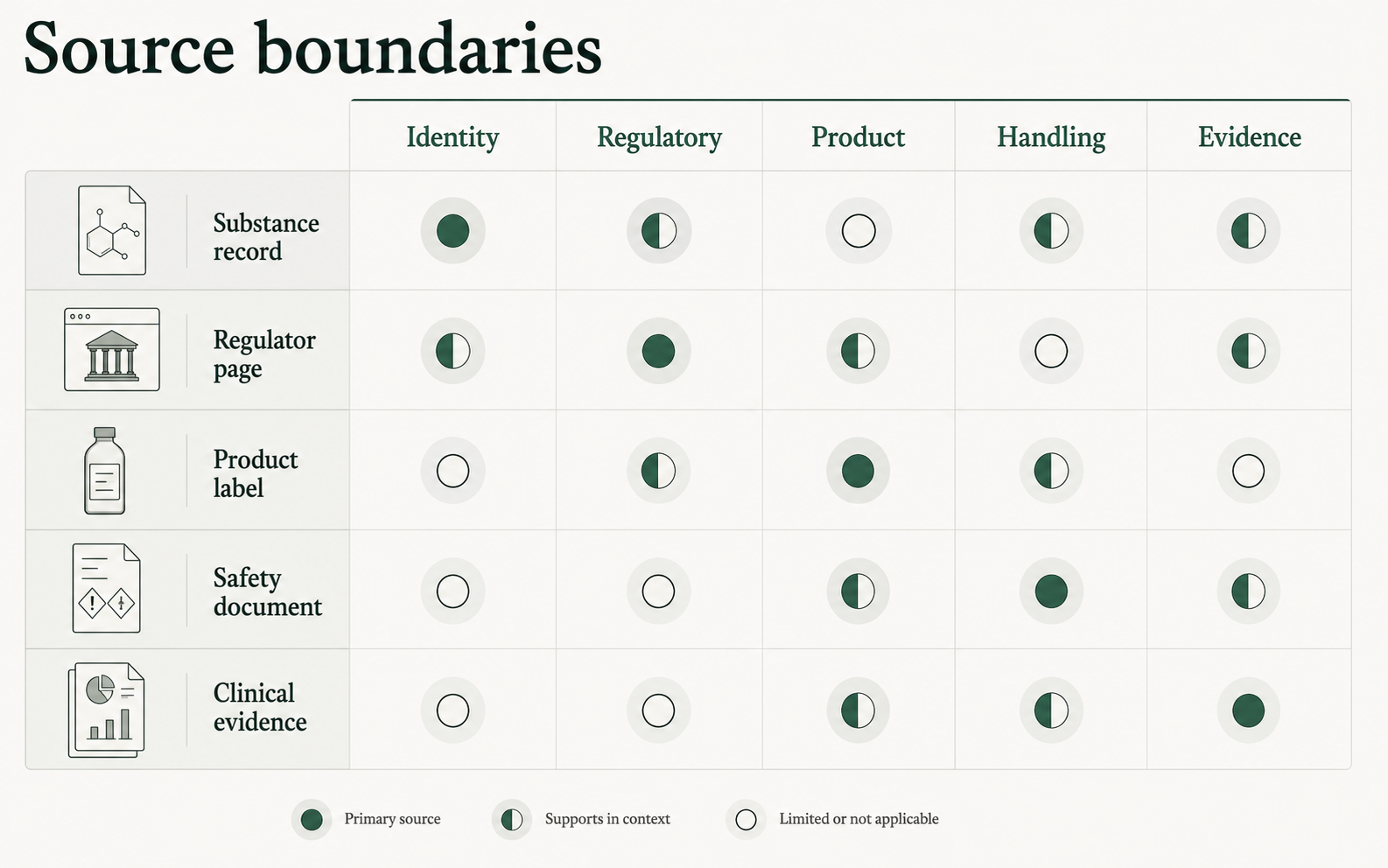
Safety data sheets can support hazard-communication, handling, storage, exposure-control, composition, and emergency-information statements for the exact material and document version being reviewed. They are not clinical evidence and should not be used to claim that a product is safe or effective for patients, approved for a use, interchangeable with another product, or suitable for a body site.
Certificates, specifications, certificates of analysis, and quality statements require the same discipline. They may support the exact batch, test, acceptance criterion, method, issuer, date, or document statement they contain. They do not, without the appropriate audited and current documentation, prove GMP compliance, compendial compliance, supplier quality, legal marketability, or product release suitability.
Writing Narrow Claims
Narrow source-backed language names the document and keeps the claim inside its scope:
- FDA GSRS lists OCTENIDINE HYDROCHLORIDE with UNII U84956NU4B and synonym mappings that include OCTENIDINE DIHYDROCHLORIDE.
- PubChem CID 51166 records Octenidine Hydrochloride and provides computed and depositor-linked identifiers for cross-checking identity work.
- ECHA substance information associates octenidine dihydrochloride with EC/List number 274-861-8 and CAS number 70775-75-6.
- EMA’s octenidine dihydrochloride MRL materials are EU veterinary maximum-residue-limit sources and should be cited as that, not generalized beyond that context.
- A product label supports claims about the specific labeled product, version, jurisdiction, and label content being reviewed.
- An SDS or certificate supports the exact handling, hazard, composition, test, batch, or documentation statement it contains, subject to document authenticity and applicability checks.
Statements that need stronger or different sourcing include approval status, market authorization, legal classification, GMP status, batch release, supplier qualification, importability, interchangeability, clinical safety, clinical effectiveness, comparative performance, and product recommendations.
Claim Boundaries
Appropriate industry source-navigation claims include:
- Which source category is being used.
- The exact identity, synonym, formula, registry number, or identifier shown in an official substance record.
- The jurisdiction, species, product type, route, or regulatory context named by an official regulator page.
- The exact product-label statement, document revision, and product scope if the label is current and product-specific.
- The exact SDS, certificate, batch, method, hazard, handling, or composition statement if the document is authentic and applicable to the reviewed material.
This page does not support:
- Supplier recommendations, vendor rankings, price comparisons, or purchasing advice.
- Import, distribution, procurement, or product-sourcing guidance.
- Claims of GMP, compendial, batch, supplier, or quality-system compliance without the appropriate audited documentation.
- Claims that availability, a catalog listing, a product webpage, or a substance identifier proves approval.
- Claims that one octenidine-containing product is interchangeable with another without product-specific and jurisdiction-specific evidence.
- Clinical superiority, safety, effectiveness, body-site suitability, or use instructions based on supplier pages, SDS language, certificates, or identity records.

Sources And Review
Last reviewed: 2026-05-07. References used here include FDA GSRS for UNII and synonym boundaries, PubChem for compound identifier cross-checks, ECHA substance and registration pages for EU chemical-source context, EMA MRL materials for a narrow EU veterinary regulatory example, and FDA/DailyMed labeling resources for product-label concepts.
This page checks source categories, access dates, claim scope, and risk boundaries. It does not assess legal status, regulatory compliance, procurement suitability, supplier quality, GMP status, market availability, product authorization, product equivalence, or clinical performance.