
Use this page when an octenidine name, identifier, or record needs to be matched carefully. It explains how to keep octenidine, octenidine hydrochloride, octenidine dihydrochloride, active moiety, and finished-product statements separate before any evidence or regulatory claim is written.
It is not a clinical-efficacy review, product authorization map, supplier-qualification guide, or formulation-substitution guide.
The Core Identity Record
For careful writing, the most useful starting point is the official record being cited, not the shortest common name. PubChem’s compound record CID 51166 is titled “Octenidine Hydrochloride” and gives the computed Hill formula C36H64Cl2N4. The same record also shows the salt-style formula C36H62N4.2ClH, which is why the record can map to the common name octenidine dihydrochloride.
FDA GSRS uses the preferred substance name “OCTENIDINE HYDROCHLORIDE” for UNII U84956NU4B and lists the formula as C36H62N4.2ClH. Its synonym list includes “OCTENIDINE DIHYDROCHLORIDE”, “OCTENIDINE HCL”, “OCTENIDINE HYDROCHLORIDE [USAN]”, and WIN 41464-2.
ECHA’s substance information record for octenidine dihydrochloride identifies the substance with EC / List number 274-861-8 and CAS number 70775-75-6. Those identifiers are useful for EU chemical-document review, but they should not be rewritten as clinical authorization or finished-product claims.
The active-moiety distinction matters. PubChem separately lists octenidine as CID 51167, with formula C36H62N4, CAS 71251-02-0, and UNII OZE0372S5A. PubChem links the hydrochloride record to octenidine as the active moiety. That relationship supports a narrow identity statement; it does not mean every salt, formulation, concentration, or product label is interchangeable.
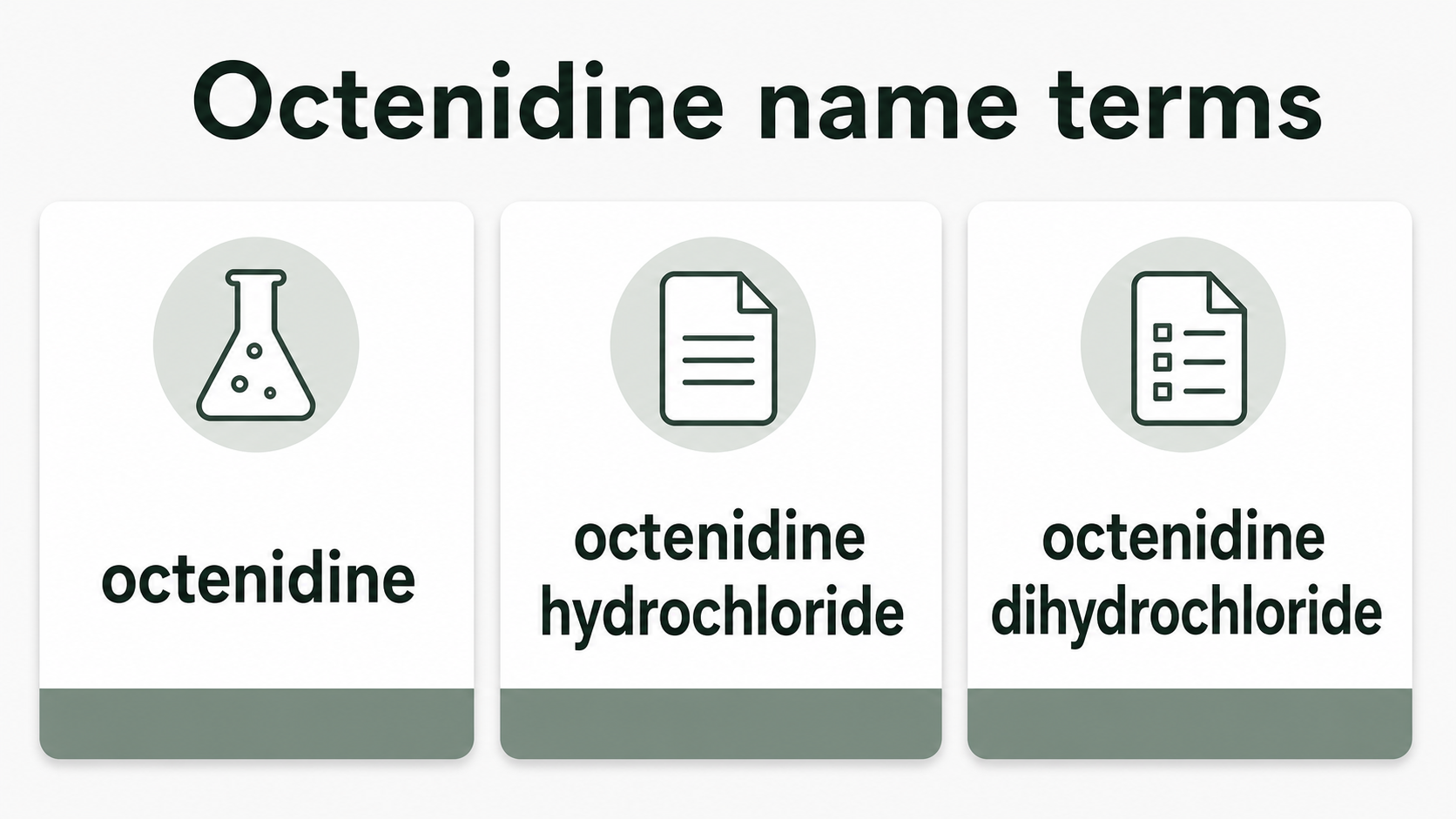
Names, Salts, And Synonyms
The clearest pattern is to preserve the source’s wording, then explain the mapping in a short note.
- Use “octenidine” when the source record or study is about the free-base or active-moiety concept.
- Use “octenidine hydrochloride” when citing FDA GSRS, PubChem
CID 51166, USAN-style naming, or literature that uses that salt name. - Apply “octenidine dihydrochloride” when the source, label, ECHA record, EMA context page, or paper uses that wording for the two-hydrochloride salt.
- Reserve “octenidine dihydrochloride / phenoxyethanol” for sources that specifically address the combination rather than the active alone.
- Save a finished-product name for claims that are product-specific and supported by a current label or regulator document for that product.
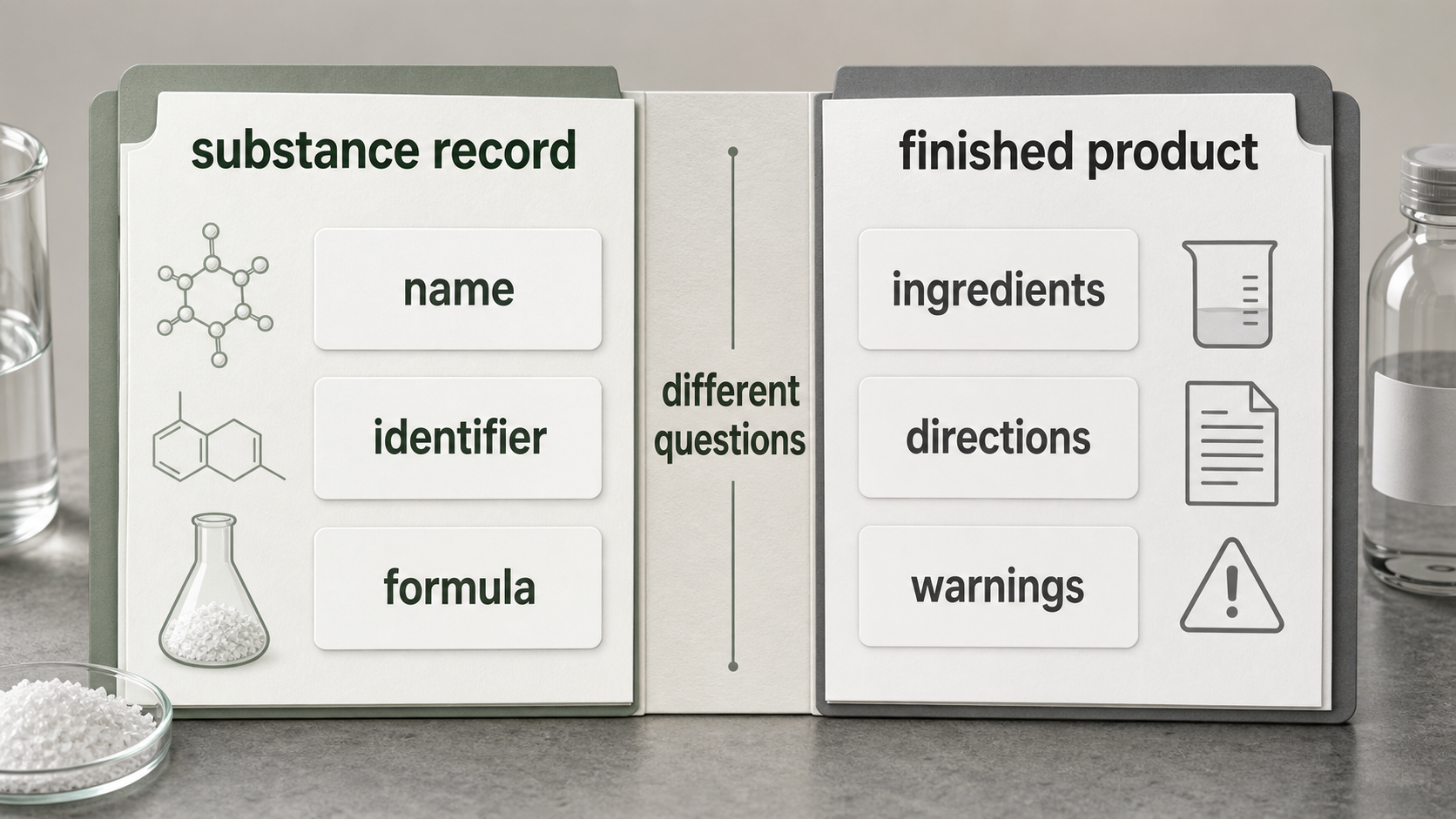
The key risk is silent normalization. A synonym in a substance record can help readers find the same identity record; it does not make all product formulations equivalent, and it does not transfer warnings, indications, concentrations, or performance data from one document type to another.
What Source Records Can And Cannot Prove
Official substance records can support statements about names, identifiers, formulae, and relationship mapping. PubChem is useful for cross-record navigation and computed descriptors, while FDA GSRS provides standardized substance identifiers used in regulated-product data systems. FDA’s GSRS page explains that the system is designed to identify substances by standardized scientific descriptions rather than relying only on variable names.
FDA GSRS also gives an important boundary for UNII use: UNII availability is not, by itself, regulatory review or approval. That point should stay visible wherever a UNII is cited on Octenidine.org.
ECHA records can support EU chemical-identity and chemical-regulatory context, such as EC and CAS identifiers. They are not clinical-trial summaries, product labels, or proof that a finished product may be used for a particular body site.
EMA pages need the same context discipline. An EMA paediatric investigation-plan page for octenidine dihydrochloride describes a specific regulatory procedure, pharmaceutical form, route, decision type, and date. EMA’s PSUSA page for octenidine dihydrochloride / phenoxyethanol is about periodic safety update assessment material for that combination. EMA’s veterinary maximum-residue-limit page is a veterinary regulatory context for food-producing species. None of those pages should be flattened into a global human-use authorization claim.
How To Read The Literature Without Overreaching
Primary literature can add context, but it must not override official identity records for names and identifiers. A 1984 Journal of Medicinal Chemistry paper describes a bispyridinamine series and identifies the dihydrochloride compound later known as octenidine as a candidate within that research program. That paper is useful as historical chemistry context, not as a current source for regulatory status.
Sedlock and Bailey’s 1985 paper studied octenidine hydrochloride, also called WIN 41464-2, with in vitro death kinetics and a nonhuman-primate skin-degerming model. It can support carefully framed microbiology-history statements about the tested organisms, concentrations, model, and endpoint. It should not be rewritten as evidence that a current finished product prevents infection in patients.
Recent mechanism papers are narrower still. Rzycki and colleagues studied octenidine and chlorhexidine interactions with model membranes using experimental and computational methods. Malanovic and colleagues studied membrane disruption and barrier-function effects in Gram-positive bacteria and model membranes. These are mechanism and model-system sources. They can inform a mechanism hypothesis, but they cannot establish clinical effectiveness, body-site suitability, or product interchangeability.
Clinical evidence reviews belong in a separate evidence map. A 2023 review of clinical studies on octenidine dihydrochloride found heterogeneous study contexts and identified the need for more studies comparing octenidine with other antiseptics for defined clinical outcomes. In this identity article, that review is used only to reinforce the boundary: clinical questions require clinical sources, not substance records or mechanism studies.
Researcher Claim Checklist
Before using an octenidine-related source, name the claim category first.
- Identity claim: cite PubChem, FDA GSRS, ECHA, or another official substance record and include the exact record name and identifier.
- Salt or active-moiety claim: state whether the source is about octenidine, octenidine hydrochloride, octenidine dihydrochloride, or a related record.
- Synonym claim: list the source that maps the synonym and keep finished products separate.
- Regulatory-context claim: name the jurisdiction, source, procedure, product or substance scope, and last-checked date.
- Finished-product claim: use a current product label or regulator document for that exact product, concentration, formulation, route, and warning set.
- Mechanism or microbiology claim: name the model, organism or membrane system, concentration, exposure time, and endpoint.
- Clinical claim: use clinical evidence sources for the exact population, product, comparator, setting, and outcome.
If the source does not answer the exact question, say that directly rather than filling the gap with chemistry, mechanism, or registry inference.

References Used
Last reviewed: 2026-05-22. References used here include PubChem, FDA GSRS, and ECHA records for identity; EMA sources for context-specific regulatory examples; and peer-reviewed chemistry, microbiology, mechanism, and clinical-review sources for evidence limits rather than patient-care claims.