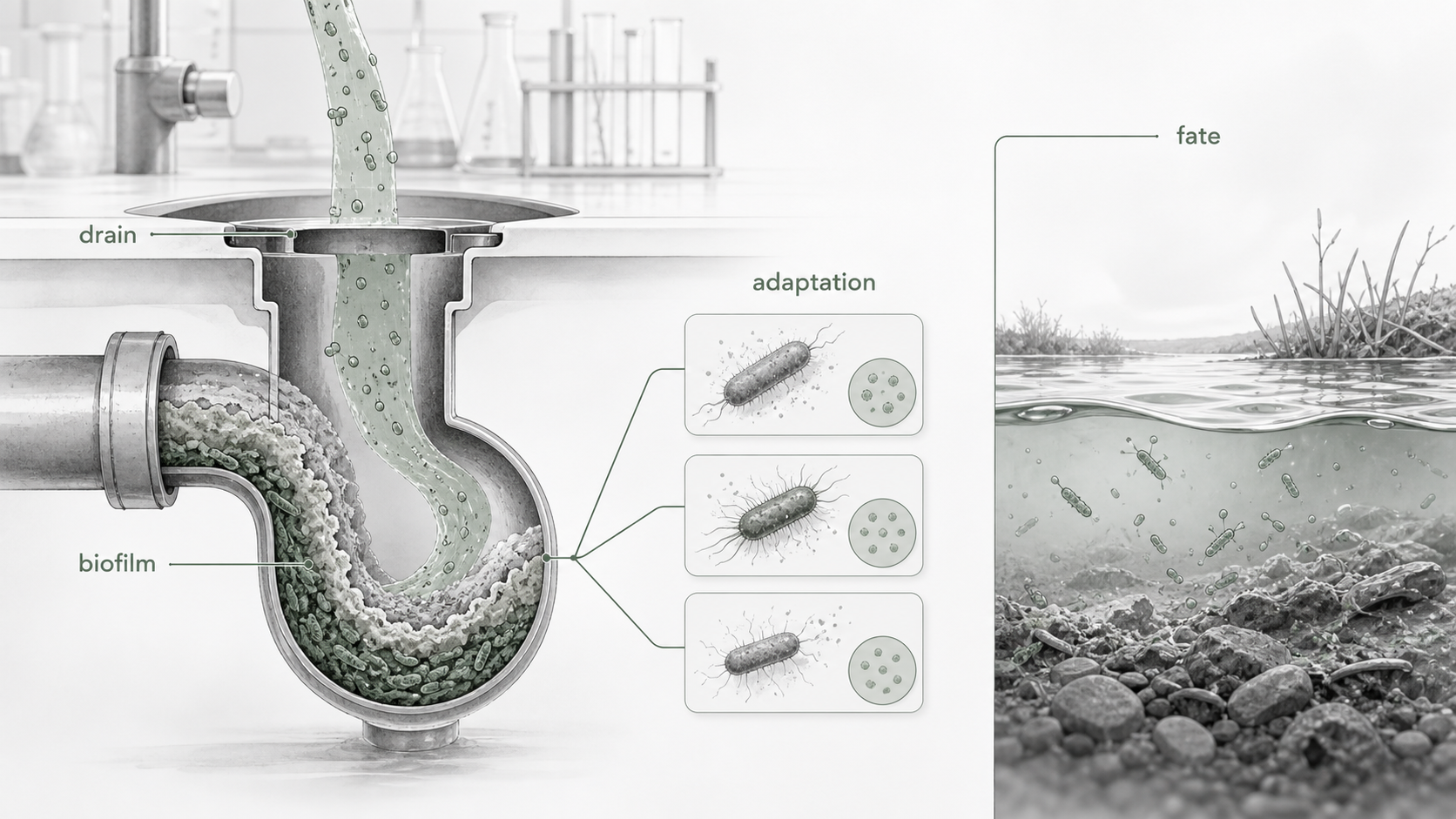
Octenidine in drains is not one question. It is a chain of related questions: how much active substance reaches a wet reservoir, whether the reservoir supports biofilm residence, whether repeated low-level exposure selects for adapted organisms, whether the compound sorbs or transforms, and how substance hazard records should be read next to measured fate data.
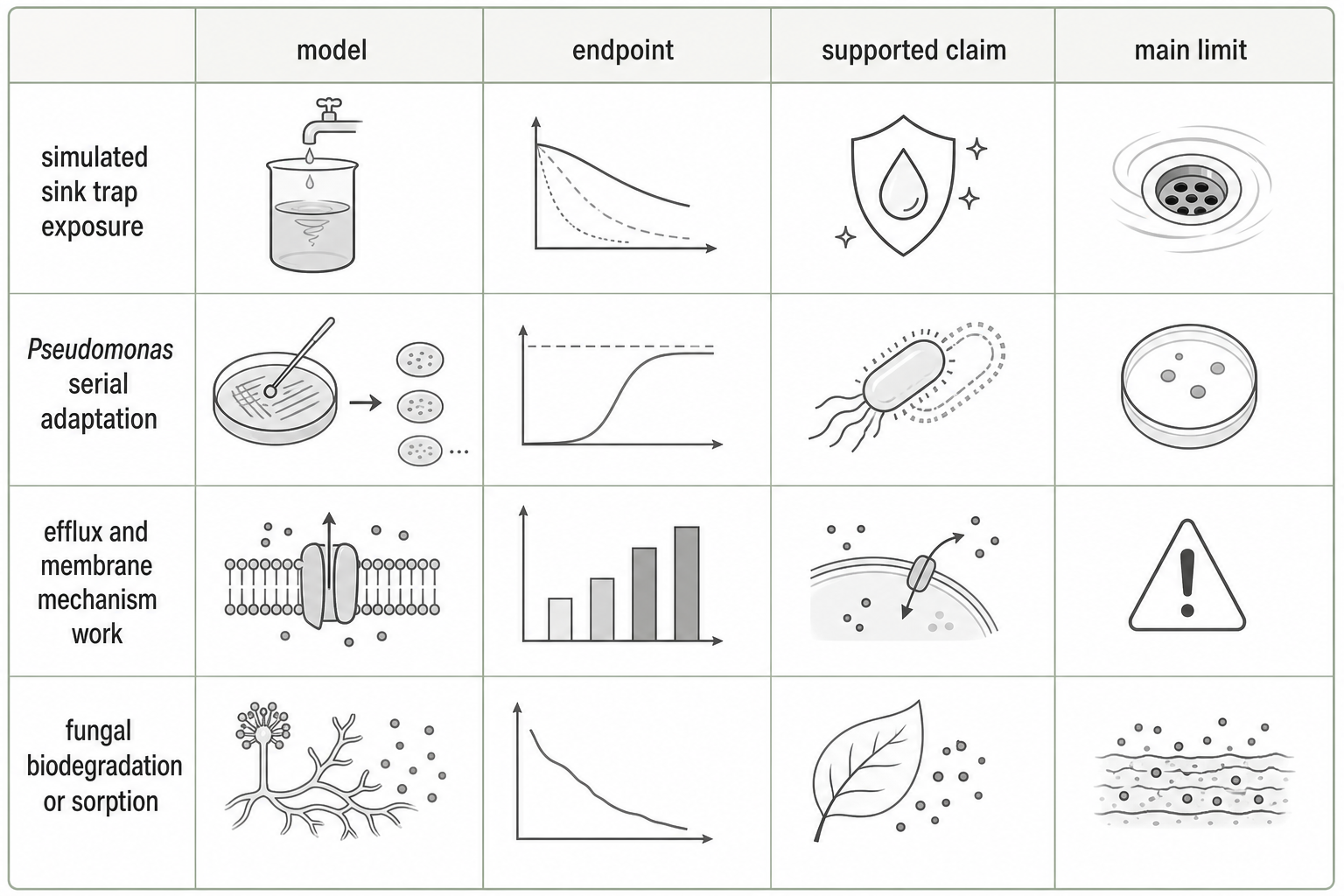
The short answer is that these claims connect, but they do not collapse into one conclusion. A simulated sink trap can show selection under repeated exposure. A Pseudomonas adaptation paper can show efflux and membrane-remodelling mechanisms. A fungal biodegradation paper can show sorption and incomplete transformation under model conditions. A PubChem or ECHA hazard record can flag aquatic hazard classifications. None of those sources alone proves a real-world exposure level, a clinical outbreak risk, or a finished-product environmental risk.
Quick Position
For evidence review, keep five questions separate:
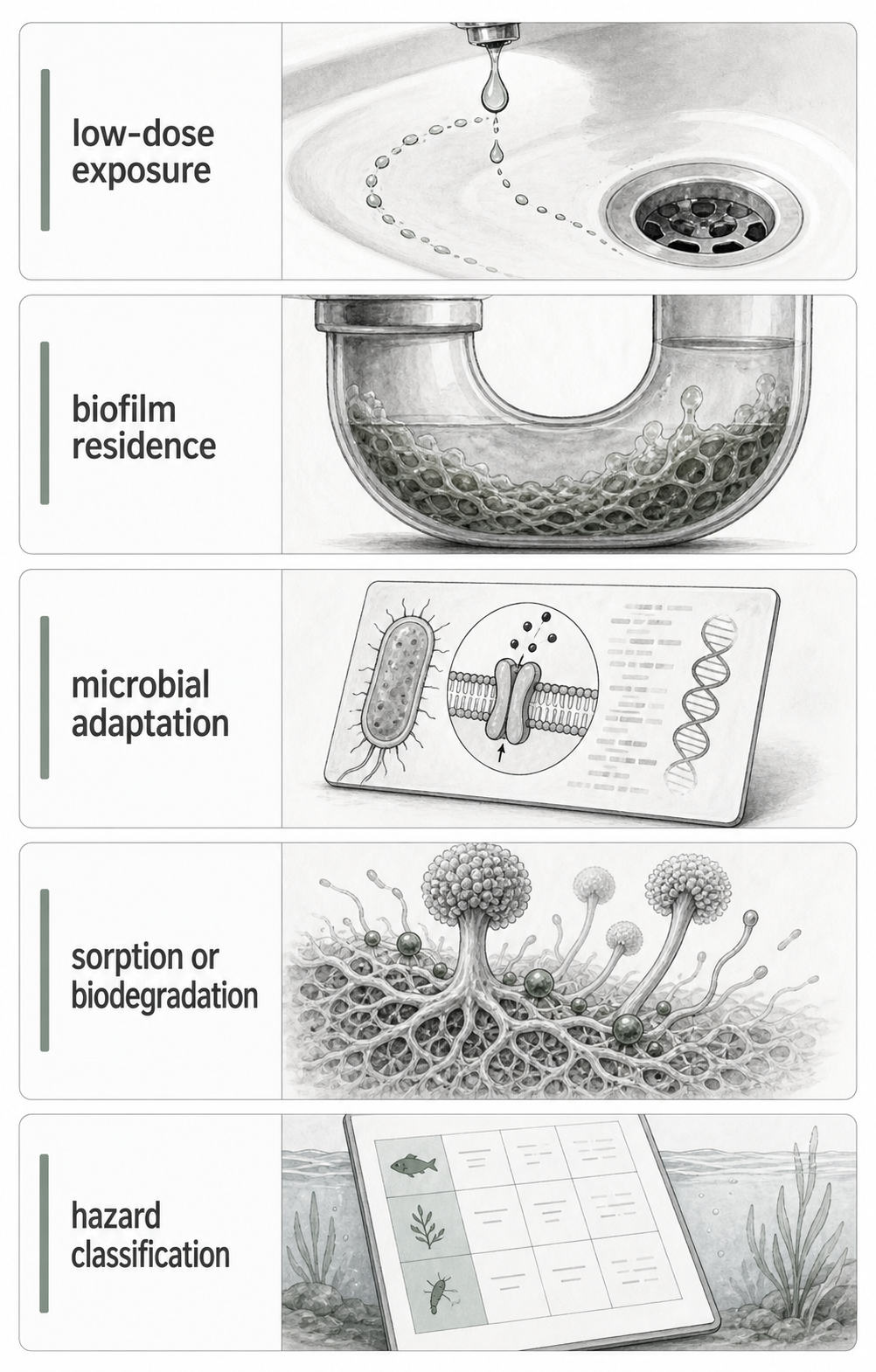
- Low-dose exposure: did a model create repeated diluted contact with octenidine or an octenidine-containing product?
- Biofilm residence: did the system include a drain, trap, or mixed community where organisms could persist between exposures?
- Adaptation: did isolates show changed MIC, MBC, tolerance, genotype, expression, growth, biofilm formation, or virulence endpoints?
- Fate: did the study measure sorption, biodegradation, transformation products, or analytical recovery?
- Hazard context: does a substance record classify aquatic hazard, and is that classification being kept separate from measured environmental concentration?
That separation lets a researcher say something useful without overstating the evidence. “Repeated low-level octenidine exposure selected for adapted isolates in a simulated sink-trap system” is a source-supported claim. “Octenidine in any drain will create antibiotic-resistant pathogens” is not.
Why Drains Matter As Research Systems
Hospital sinks and drains are not just pipes in infection-prevention literature. They can be wet, nutrient-variable reservoirs with established mixed microbial communities, including organisms that matter in healthcare outbreaks. That makes a sink trap a plausible place to ask what happens when a biocide does not arrive as a clean, full-strength exposure on a dry surface, but as repeated low-level input into a resident microbial system.
The 2021 Applied and Environmental Microbiology sink-trap study used hospital sink waste traps placed into a laboratory tap rig. The authors described the original trap water as containing culturable Gram-negative organisms, then studied the effect of prolonged exposure to low doses of a commercial octenidine-containing product. Phenotypic and genotypic analyses found increased octenidine tolerance in Pseudomonas aeruginosa, associated with mutations in the Tet repressor SmvR. Enterobacter isolates showed increased tolerance to several other cationic biocides, though not octenidine in the same way, with RamR mutations. Citrobacter isolates carried RamR and MarR changes linked in the paper to antibiotic-resistance changes.
The useful point is not that a drain study equals a hospital outcome. The useful point is narrower and still important: a simulated sink-trap environment can maintain organisms through repeated low-level biocide exposure and can select for phenotypes and mutations that deserve infection-prevention attention.
What The Pseudomonas Adaptation Study Adds
The 2018 Journal of Hospital Infection paper gives the drain question a more focused Pseudomonas frame. In the laboratory arm, seven clinical P. aeruginosa isolates were exposed to increasing octenidine concentrations over several days. The authors measured fitness, MBC at 1 minute, 5 minutes, and 24 hours, and MICs for several antimicrobials. They also studied P. aeruginosa from a hospital drain-trap population exposed to a diluted octenidine formulation four times daily for three months.
The abstract reports stable adaptation after continuous exposure, with increased tolerance to octenidine formulations and chlorhexidine up to 32-fold in the laboratory system. In the simulated clinical setting, the authors reported up to eight-fold increased tolerance to octenidine and chlorhexidine after continuous exposure of a multispecies community; that increase was lost after octenidine was removed.
That last detail matters. A reversible or exposure-dependent population signal is not the same as a permanent species-wide rule. It still supports a practical research concern: repeated low-level exposure can change measured susceptibility in P. aeruginosa under the tested conditions.
The Sink-Trap Study Broadens The Organism Question
The 2021 sink-trap paper moves beyond one organism. It reported that P. aeruginosa, Citrobacter, and Enterobacter isolates persisted or emerged in the model and that the effects differed by organism. For P. aeruginosa, decreased susceptibility to octenidine was tied to SmvR changes. For Enterobacter and Citrobacter, the pattern involved other regulatory genes and other antimicrobial susceptibility changes.
That species-specific pattern is easy to flatten, so it should be kept visible. “Drain exposure selected for mutations in efflux-pump regulators” is a better summary than “octenidine made everything resistant.” The former preserves the model, the organism set, and the mechanism class. The latter drops the hard parts.
The same paper also states a key limitation: the study did not directly analyze the intact sink-trap biofilm in depth. Sampling trap water can miss organisms in deeper biofilm layers, Gram-positive organisms, and viable-but-nonculturable cells. That limitation does not cancel the finding. It tells the reader what the model can and cannot show.
Mechanism: Efflux First, Membrane Remodelling Later
The 2021 Communications Biology paper helps explain how P. aeruginosa adaptation can occur. The authors characterized octenidine-adapted P. aeruginosa from laboratory and simulated clinical settings using genome sequencing, gene expression work, and metabolomics. They reported that a 2- to 4-fold increase in octenidine tolerance was associated with stable mutations including a 12-base-pair deletion in smvR, linked to increased expression of the MFS efflux pump SmvA.
Higher-level adaptation involved additional mutations, most often in phosphatidylserine synthase pssA and sometimes in phosphatidylglycerophosphate synthase pgsA. The paper connects those changes to altered membrane composition and order, with tolerance increases reported far above the early SmvR-only stage in adapted strains.
This is where the phrase “adaptation” earns its keep. The mechanism paper does not merely report a different MIC. It separates an early efflux-regulator step from later membrane-related steps. It also shows why a sink model using sub-MIC exposure may not produce the same mutational profile as a laboratory selection pushed to higher octenidine concentrations.
For writing, the safest formulation is: in P. aeruginosa, repeated octenidine exposure can select mutations affecting SmvR/SmvA-mediated efflux, and higher-level laboratory adaptation can add phospholipid-pathway changes. That is different from saying every environmental exposure will create high-level octenidine tolerance.
Biofilm Residence Is Not The Same As Biofilm Measurement
Drain traps matter partly because they can contain mixed biofilms. But “biofilm-associated system” and “direct biofilm analysis” are not the same thing.
In this evidence set, the sink-trap papers are strongest for repeated exposure, culturable isolates, susceptibility changes, and genomic signals from sampled populations. They are less complete for intact biofilm architecture, concentration gradients inside the biofilm, sorbed octenidine in the matrix, dormant cells, and spatial relationships between species.
That distinction prevents two opposite errors. One error is to ignore biofilms because the endpoint was MIC or MBC. The other is to treat a sink-trap population result as if it mapped the whole biofilm. The better reading is that drains are biologically plausible reservoirs and that the cited studies show selected culturable-population outcomes within simulated drain systems.
Sorption And Biodegradation Answer A Different Fate Question
Environmental fate evidence asks where the molecule goes and what happens to it. That is not the same as asking whether a bacterium adapts.
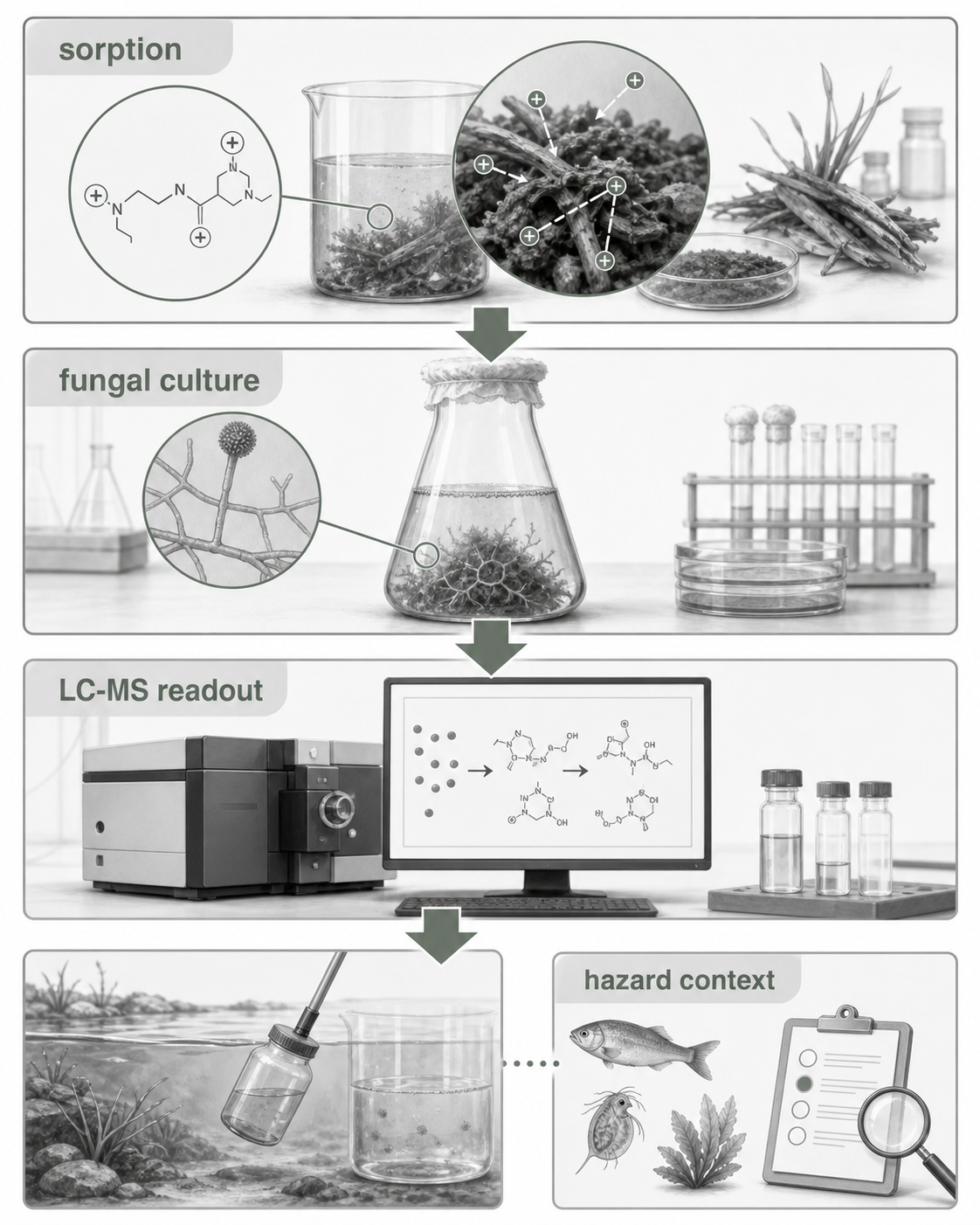
The 2020 Molecules paper studied chlorhexidine and octenidine with two ligninolytic fungi, Irpex lacteus and Pleurotus ostreatus. The authors used in vivo fungal cultures and in vitro concentrated extracellular liquids, then measured residual compound and transformation products by chromatographic and mass-spectrometric methods.
For octenidine, the paper reported up to 48% +/- 7% removal in the 21-day in vivo experiment compared with heat-killed controls, but it also emphasized strong sorption to fungal biomass. That sorption made it difficult to say how much removal reflected enzymatic biodegradation rather than binding. The authors detected metabolites indicating transformation, but complete biodegradation was not achieved.
This is a good example of a fate result that should be stated carefully. “Octenidine was partly removed from solution in a fungal model” is not the same as “octenidine biodegrades readily.” In that paper, sorption is part of the result, not a nuisance detail to discard.
Sorption Can Lower Water Concentration Without Removing Hazard
Octenidine is a cationic antimicrobial. In practical fate reading, that means binding to negatively charged biomass, sludge, sediment, or biofilm matrix is plausible and can change measured water concentration. But sorption is not the same as mineralization, detoxification, or disappearance from the environment.
That distinction matters for wastewater and drain interpretation. A compound may become less measurable in the water phase because it is bound to biomass. It may also remain biologically relevant if it is bioavailable at the surface where organisms live, or if it desorbs under other conditions. The cited fungal paper does not settle those downstream questions. It shows why analytical recovery, biomass binding, and transformation products should travel with any fate claim.
For researchers, the review question is not simply “was octenidine removed?” It is “removed from which phase, by which mechanism, under which extraction and measurement conditions?”
Hazard Records Are Not Exposure Measurements
PubChem lists octenidine hydrochloride as CID 51166, with CAS 70775-75-6 and molecular formula C36H64Cl2N4 for the salt-style record. PubChem’s hazard section aggregates ECHA Classification and Labelling notification data and includes aquatic hazard statements reported by notifiers, including very toxic or harmful-to-aquatic-life wording depending on notification.
ECHA’s public brief-profile context for octenidine dihydrochloride also places the substance in an aquatic hazard frame. That is useful hazard context for researchers, especially when reading fate studies. It should not be converted into a measured environmental concentration or finished-product risk estimate.
Hazard, exposure, persistence, bioavailability, and adaptation are different layers. A hazard classification says what the substance can do under classification logic. A biodegradation study asks whether a model system transforms it. A drain study asks what a resident microbial community does under repeated exposure. A risk assessment would need dose, dilution, removal, partitioning, transformation products, receiving environment, organism sensitivity, and use pattern.
How To Write The Claim Without Overreaching
A strong researcher-facing claim keeps the model attached:
- In a simulated sink-trap system, repeated low-level exposure to an octenidine-containing product selected for P. aeruginosa isolates with increased octenidine tolerance linked to SmvR changes.
- In P. aeruginosa laboratory adaptation, early SmvR/SmvA efflux changes and later phospholipid-pathway changes help explain stepwise octenidine tolerance.
- In a ligninolytic fungal fate model, octenidine removal from the measured phase was limited by strong biomass sorption, and complete biodegradation was not shown.
- Hazard records support aquatic hazard context for the substance, but they do not measure real-world drain concentration or environmental exposure.
Those sentences are less dramatic than a single sweeping conclusion. They are also more useful. They tell a reviewer what to verify next: dose pattern, community structure, organism, endpoint, analytical recovery, and classification source.
What This Evidence Does Not Settle
These studies do not settle whether any particular hospital should use, stop using, substitute, neutralize, or dispose of a finished octenidine product in a specific way. They also do not establish a universal environmental concentration, a universal persistence half-life, or a universal risk threshold.
That boundary is important because infection prevention and environmental fate can pull in different directions. Biocides can remain important tools for infection prevention while low-level environmental exposure remains a legitimate research question. The clean review position is to hold both facts at once and ask better model-specific questions.
Sources And Review
The main sources are the 2021 Applied and Environmental Microbiology simulated sink-trap exposure study, the 2018 Journal of Hospital Infection Pseudomonas adaptation study, the 2021 Communications Biology efflux and membrane-remodelling mechanism paper, the 2020 Molecules fungal biodegradation and sorption paper, and PubChem/ECHA identity and aquatic hazard context.
This page is a research-interpretation brief, not consumer disposal advice or a hospital protocol. Its main boundary is that product exposure pattern, organism identity, MIC and MBC wording, gene symbols, sorption and biodegradation language, and PubChem/ECHA hazard wording need to stay attached to the source that supports them.