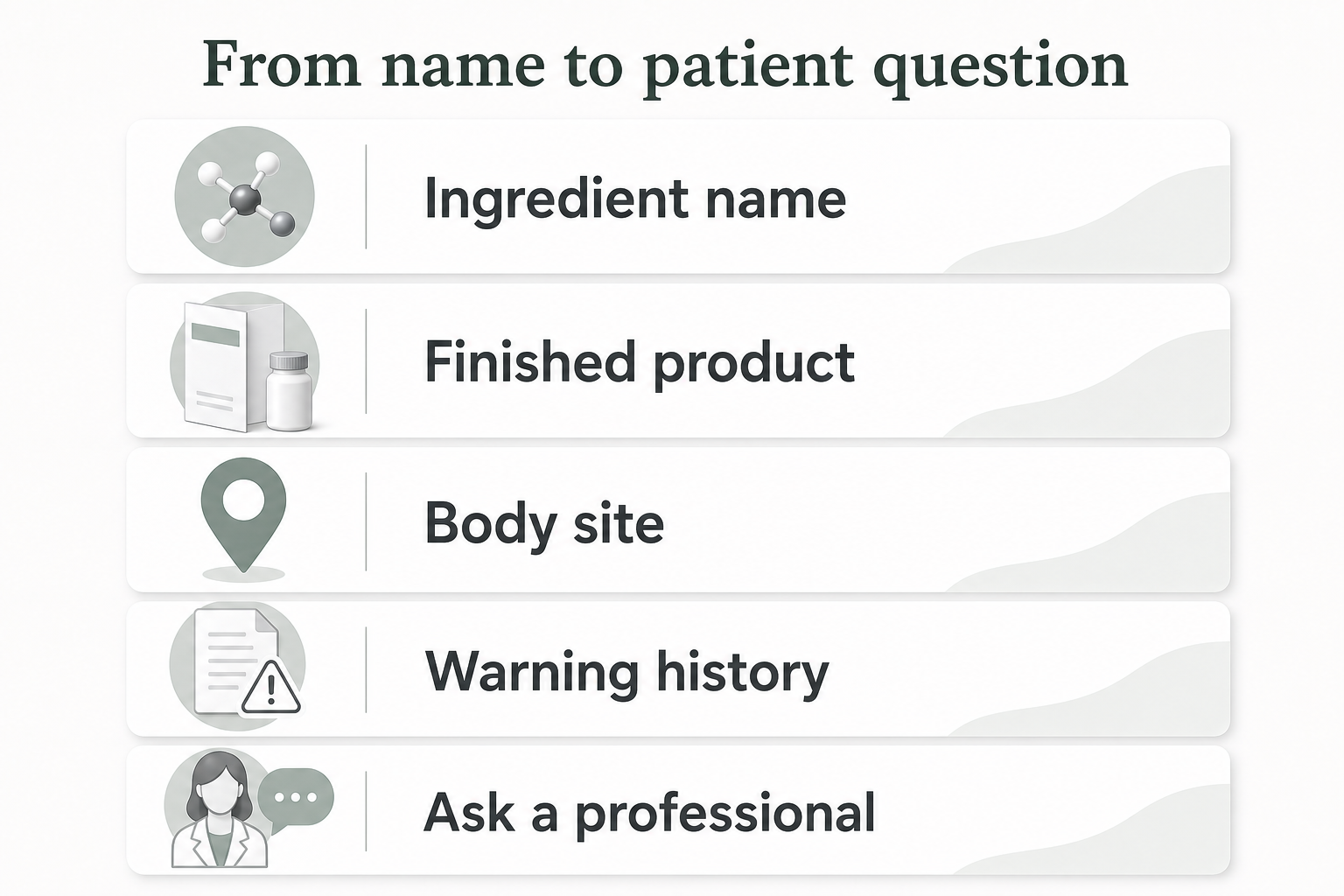
A dentist, pharmacist, nurse, clinician, or relative abroad may mention “Octenisept,” “octenisan,” “octeniderm,” “octenilin,” “octenidol,” or “Octeangin.” The most useful first question is simple: which exact product did they mean?
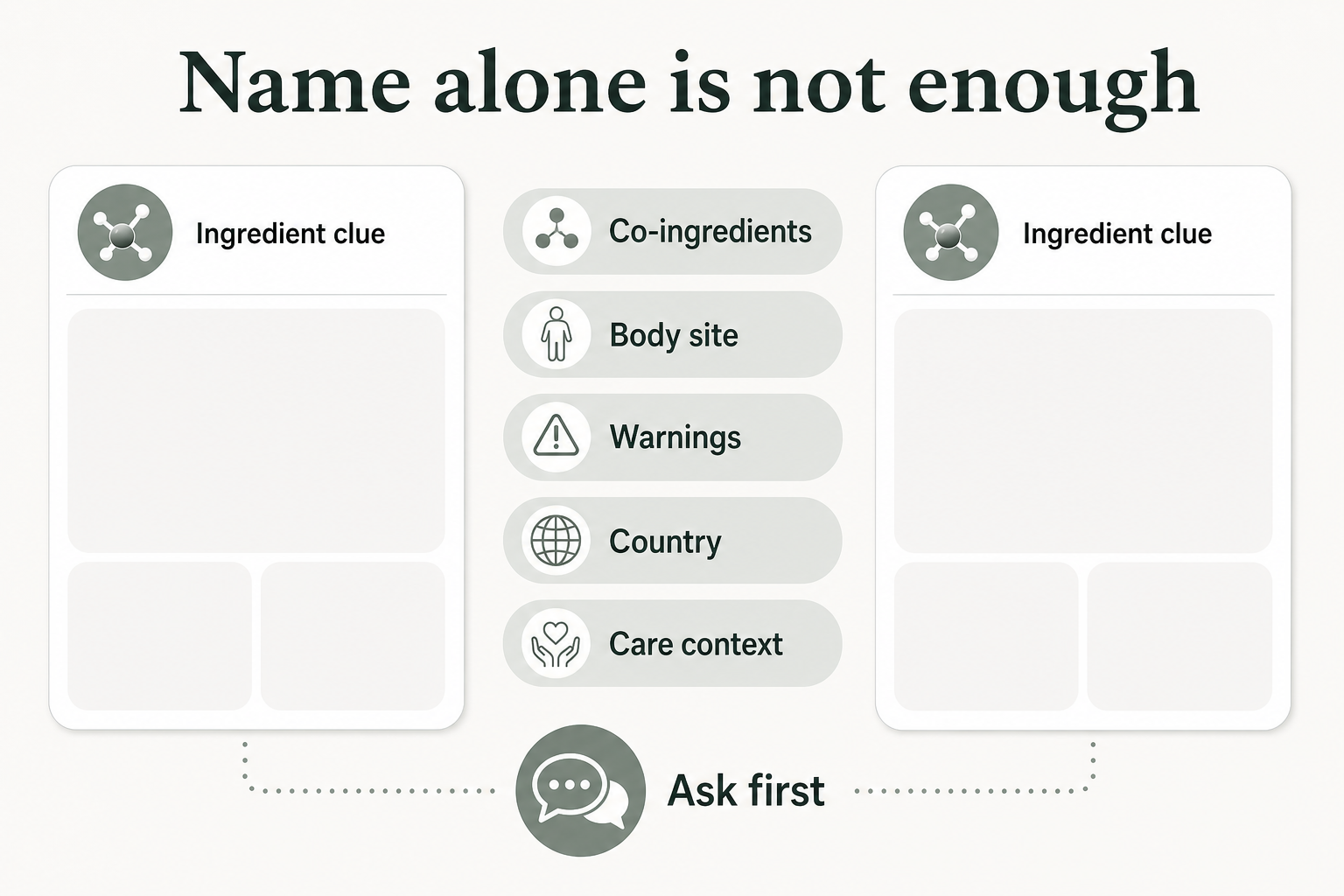
Octenidine is an antiseptic ingredient. A product name is only a clue. Products with related names can have different active ingredients, co-ingredients, alcohol content, warnings, body-site directions, and country labels.
We name real products here so you can identify the exact product before asking a pharmacist, dentist, nurse, or clinician.
Start with the exact label
“Octenidine” tells you the ingredient family. The finished product supplies the country, intended body site, warnings, and reason a professional mentioned it.
When you have the product or a photo of it, look for the active ingredient line first. It may say octenidine hydrochloride, octenidine dihydrochloride, or octenidine HCl. Then keep going: the full product name, co-ingredients, concentration, country, body-site directions, warnings, expiry date, and leaflet all matter.
Start with the package or leaflet if you have it. Product registers and manufacturer pages can help identify a product when the package is missing or from another country. Poison Help or a local poison-control service is for exposure questions.
Why country matters
Octenidine products are more familiar in some European, Australian, Malaysian, Singaporean, UK, and international product contexts than on a routine U.S. over-the-counter antiseptic shelf. If you are in the United States and heard one of these names, it may have come up through travel, dental care, wound care, a hospital or clinic, a relative abroad, or a search after someone mentioned the word.
Country matters because a product can be listed, labeled, or supplied differently in different places. For example, Octenisept appears in Australian and Malaysian materials as an octenidine-and-phenoxyethanol product, and European documents list several national octenidine product names. Those details can help identify what was meant. They do not make a product from one country the same as a product in another country.
Manufacturer pages can also help identify a current product family, but they are still company descriptions of company products. Use them to ask a better question, not to decide that a product should be used in your situation.
What kind of product was meant?
The same ingredient clue can show up in products that belong to different families. A wound gel and a throat lozenge are not interchangeable just because both names are connected to octenidine.
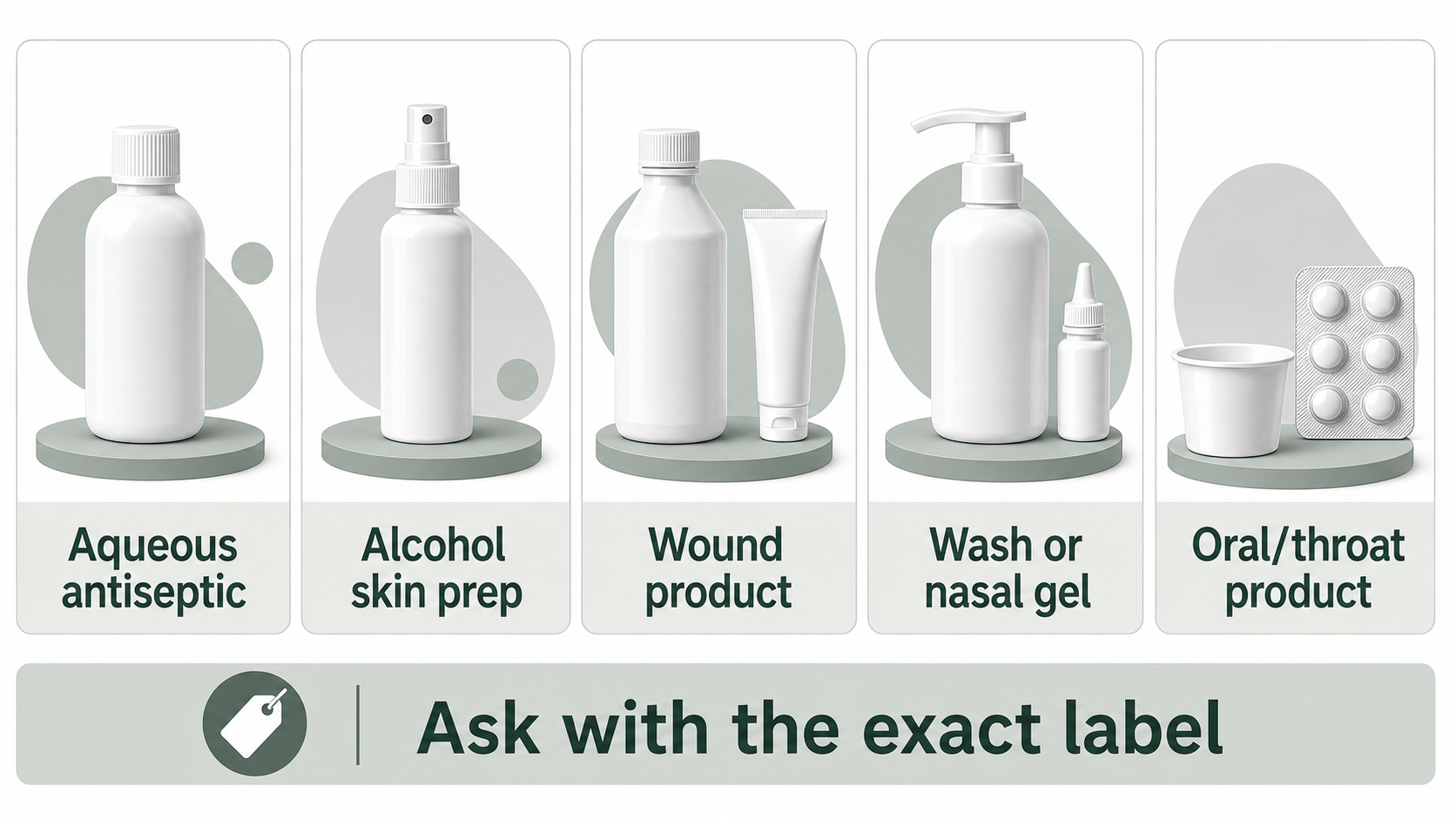
Questions by product family
| Name you may hear | Question to ask | |
|---|---|---|
| Aqueous skin, wound, or mucous-membrane antiseptic | Octenisept and national-name equivalents for aqueous antiseptic products. | Which exact product is being discussed, which country does it come from, and which body site is it for? |
| Alcoholic skin antiseptic | octeniderm colourless, described by the manufacturer as octenidine dihydrochloride with 1-propanol and 2-propanol. | Is this for clinic or procedure prep, and do alcohol-related cautions apply to my situation? |
| Wound irrigation or wound gel | octenilin wound irrigation solution and octenilin wound gel, each with octenidine HCl shown in the ingredient line. | Is this part of a written wound-care plan, and when should I contact the care team again? |
| Wash or nasal gel | octenisan wash lotion and octenisan md nasal gel, each tied to a specific body or nasal-vestibule context. | Was this brought up for decolonisation, surgery preparation, hospital admission, or another supervised reason? |
| Oral or throat products | octenidol mouth rinse, Octeangin lozenges, Laryngomedin Octenidin Antisept, Octenident, and other national entries. | Which exact oral product did the dentist, doctor, or pharmacist mean? |
A few names you may hear
Octenisept often refers to an aqueous antiseptic product containing octenidine and phenoxyethanol. The useful patient question is which country’s label applies, which body site or care situation was being discussed, and what the leaflet says about warnings.
octeniderm colourless sits in a different product family. It is described as an alcoholic skin antiseptic with octenidine dihydrochloride, 1-propanol, and 2-propanol. Alcoholic skin preps and aqueous antiseptics come with different practical questions.
octenilin wound irrigation solution and octenilin wound gel are wound-product examples. If one of these names comes up, the question is whether it is part of a wound-care plan a clinician actually gave you, and what symptoms or changes should make you contact the care team again.
octenisan wash lotion and octenisan md nasal gel show why body site matters. One is a wash lotion. The other is a nasal-vestibule gel with product-specific cautions. Same name family, different product questions.
octenidol, Octeangin, Laryngomedin Octenidin Antisept, and Octenident are oral or throat examples. Ask the dentist, doctor, or pharmacist which exact product was meant. A mouth rinse, lozenge, and other oral product can carry different warnings.
What to bring with you when you ask
The conversation gets a lot easier when the professional can look at the actual product instead of guessing from memory. So gather what you can before the appointment or the call:
- the exact product name as it appears on the packaging
- the country it was supplied in, if you know
- clear photos of the front label, back label, carton, and leaflet
- the active ingredients and their concentrations, if those are listed
- any co-ingredients, including phenoxyethanol or alcohols
- the body site or product category named on the label
- the warning language about allergies, eyes, ears, mouth, nose, mucosal areas, wounds, children, pregnancy, or breastfeeding
- the expiry date, lot or batch code, storage instructions, and the sponsor or distributor contact details
- who mentioned the product to you, the reason they brought it up, and anything else being used on the same area
If the label is in a language you do not read, do not try to translate it from memory. Photograph it clearly. A pharmacist, clinician, dentist, the manufacturer, or your local regulator can often help identify the active-ingredient line and the warning sections from a label image.
Same Ingredient, Different Product
Two products that both mention octenidine can still vary in salt form, concentration, co-ingredients, alcohol content, product category, body site, country, warnings, directions, packaging, expiry rules, and care context.
When to stop reading and get help
If an exposure has already happened, a reaction is unfolding, or someone’s symptoms are getting worse, stop trying to identify the product first. Call poison control, Poison Help in the U.S. at 1-800-222-1222, or emergency services.
For wounds, deep cuts, punctures, burns, surgical sites, spreading redness, pus, fever, severe pain, or bleeding that is hard to control, follow the instructions from your care team or use a local urgent-care pathway.
A simple way to ask
One useful trick: open with the uncertainty itself, instead of asking for a yes-or-no recommendation. You might say something like this.
“I heard the name octenidine, but I am not sure which product was meant. Here is the label and the leaflet I have. Is this the same product you were talking about, and are there warnings on it that matter for me?”
That phrasing puts the decision where it belongs, with the person who actually knows your health situation and can look at the exact label in front of you.
Common questions
Is Octenisept the same as octenisan?
No. They are different product names that belong to different product families. Octenisept is usually tied to an aqueous antiseptic context, while octenisan covers examples like wash lotions and nasal gels. If both names have come up in your situation, ask which exact product was meant.
If a product has octenidine on the label, can I use it on any part of the body?
No. Body site is product-specific. A wound product, a nasal gel, an oral rinse, a skin prep, and a mucous-membrane antiseptic can all carry different warnings and directions, even when they share an ingredient name.
What are manufacturer pages useful for?
They can help identify a current product, its formulation, its product family, its ingredients, and its warnings. They should not be read as product endorsements or as clinical proof for your situation.
What should I do if the label is not in English?
Bring the product itself, plus clear photos of the labels, to a pharmacist, clinician, dentist, or your local regulator contact. Translating a brand name from memory is the part to avoid; the label is the part to bring.
Are these products on the routine U.S. over-the-counter shelf?
Most of the named finished-product examples here come from EU, Australian, Malaysian, Singaporean, UK, or international manufacturer sources. U.S. identity records confirm the substance name, but they do not turn a foreign product into a U.S. OTC drug.
If I cannot find the octenidine product that was named, can I just use a chlorhexidine or povidone-iodine product instead?
Do not substitute antiseptics on your own, even within what looks like the same ingredient family. Go back to the professional who named the product, because formulation, body site, allergy history, procedure context, and local labels all differ between products.
Related reading
For a broader overview of the product names you might run into, see The octenidine product family, in plain English. If you want background on the ingredient itself, What octenidine is, in plain English is the place to start. To prepare for an appointment where this came up, read Questions to ask before using an octenidine-containing product. And if you are weighing this name against a chlorhexidine product someone else has mentioned, see Octenidine vs Hibiclens and chlorhexidine: questions to ask.
Sources and review
Last reviewed: 2026-05-13. Sources include regulator records, patient leaflets, poison-control resources, wound-care guidance, and manufacturer product pages for the examples named above.