This article explains how mechanism sources describe octenidine antiseptic action and where those sources stop. It is written for readers who need to separate molecular identity, laboratory findings, model systems, and clinical interpretation.
Mechanism evidence is not patient-outcome evidence. A membrane model, organism assay, animal model, or computational study can support a mechanistic explanation, but it should not be rewritten as a treatment claim, a product instruction, or a statement that resistance cannot occur.
Quick Position
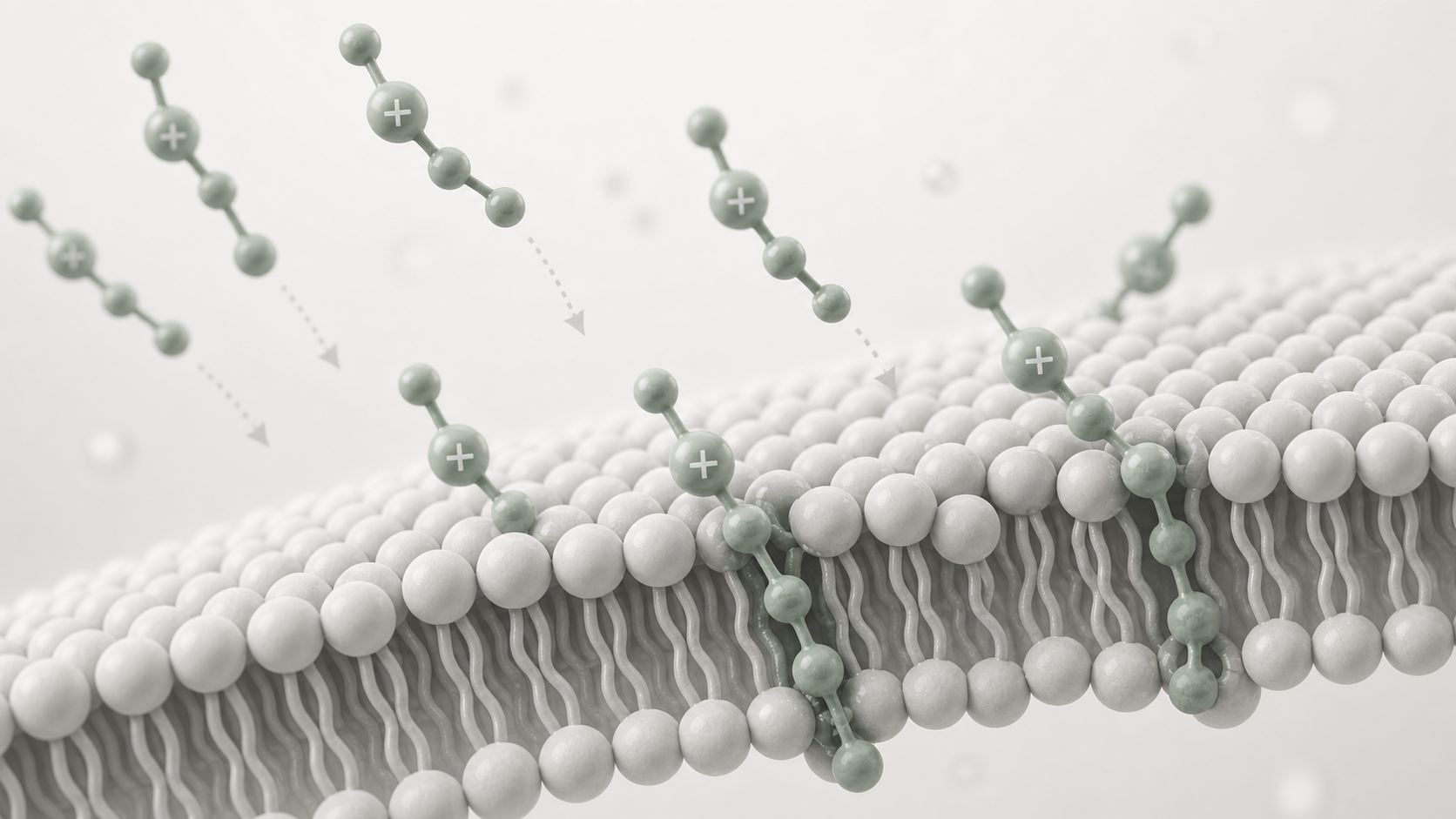
Octenidine is generally discussed in mechanism papers as a cationic, membrane-active antiseptic. Official identity sources help keep the substance names aligned: FDA GSRS lists octenidine hydrochloride with octenidine dihydrochloride as a synonym, while PubChem records the hydrochloride salt and links it to the parent compound octenidine.
Mechanism papers then ask narrower questions. Early microbiology work measured organism killing and skin-degerming activity in nonhuman primates. Later work used Escherichia coli, model membranes, microscopy, surface charge measures, fluorescence methods, scattering, and molecular dynamics to study how octenidine interacts with cell envelopes and lipid bilayers.
The recurring theme is membrane disruption, but the exact wording matters. Name the source system before naming the mechanism.
Keep The Name Attached To The Source
Mechanism sources do not always use the same name. One source may say octenidine hydrochloride, another octenidine dihydrochloride, another octenidine dichloride, and another simply octenidine. Those names may be close in a chemistry record, but the source’s own terminology should remain visible.
That matters because research claims may refer to:
- The active moiety.
- A salt form.
- A finished product.
- A model compound abbreviation such as OCT.
- A combination product or formulation in a clinical context.
Identity records support synonym mapping. They do not establish mechanism, clinical effectiveness, product authorization, or body-site suitability.
What The Early Microbiology Study Supports
The 1985 Antimicrobial Agents and Chemotherapy study evaluated octenidine hydrochloride as a topical microbicide using in vitro death kinetics and a cynomolgus monkey skin-degerming model. It tested several organisms, including Staphylococcus aureus, Staphylococcus epidermidis, Proteus mirabilis, Streptococcus pyogenes, Klebsiella pneumoniae, Escherichia coli, Pseudomonas aeruginosa, Serratia marcescens, and Candida albicans.
That study supports historical and microbiology context. It should not be used as a modern clinical effectiveness claim or as a general product comparison for patients. The organism list, concentration conditions, exposure time, formulation, animal model, and extraction method are all part of the claim.
What Later Mechanism Papers Add
The 2020 International Journal of Antimicrobial Agents paper studied octenidine action against Gram-negative bacteria using E. coli and model membranes. The authors reported that octenidine neutralized E. coli surface charge, disrupted the outer membrane, penetrated toward the inner membrane, and induced lipid disorder in model membrane systems.
That is a mechanistic model, not a clinical endpoint. It can support language such as “has been studied as a membrane-active antiseptic in E. coli and model membrane systems.” It does not support language such as “will treat infection” or “prevents wound infection.”
The 2021 Biophysical Journal study tested whether electrostatics alone explains membrane selectivity for octenidine and chlorhexidine. It used molecular dynamics, zeta potential with dynamic light scattering, vesicle fluctuation spectroscopy, leakage measurements, fluorescence methods, and model membrane systems. The authors concluded that octenidine membrane disruption and selectivity appeared more complicated than simple electrostatic attraction.
That source is useful because it raises the bar for mechanism wording. “Cationic” does not mean the mechanism is fully explained by charge. The model system, lipid composition, concentration, and method determine what the source can support.

Useful Mechanism Wording
Prefer wording that keeps evidence scope visible:
- “In vitro and model-membrane studies describe octenidine as membrane-active.”
- “The 2020 E. coli study reported surface-charge neutralization and membrane disruption in its experimental system.”
- “The 2021 membrane study cautions against reducing selectivity to electrostatics alone.”
- “Mechanism findings are compatible with broad antimicrobial activity, but they do not establish patient outcomes.”
Wording that overreaches:
- “Octenidine cures infection.”
- “Membrane action means resistance is impossible.”
- “Laboratory potency proves clinical superiority.”
- “The mechanism applies equally to every product, wound type, body site, or population.”
Resistance Questions Need Separate Evidence Review
Some mechanism papers discuss broad-spectrum action or the possibility that nonspecific membrane activity may make resistance less likely. Treat that as a source-specific interpretation, not as a settled clinical or ecological conclusion.
Resistance, tolerance, reduced susceptibility, and adaptation require organism-specific methods, serial exposure design, surveillance context, genetic analysis when applicable, and clinical relevance. Those topics need separate evidence review. A mechanism explanation can introduce why the question matters, but it cannot close the question.
Safety Language Also Needs Separate Sources
Mechanism studies may include comments about tolerability, selectivity, or mammalian cells. Keep the model visible. It is acceptable to say that a source studied epithelial cells, animal skin, or model membranes if the source did so. It is not acceptable to turn that into a general safety statement for people.
Safety claims about skin, mucosa, wounds, eyes, ears, infants, pregnancy, burns, device-related care, or damaged tissue require product labels, clinical sources, and jurisdiction-specific review.
How To Use Mechanism Sources
For a mechanism claim, name four things:
- The chemical term used by the source.
- The model system, such as E. coli, membrane vesicles, or computational membrane model.
- The method, such as microscopy, fluorescence, scattering, susceptibility testing, or molecular dynamics.
- The endpoint, such as leakage, depolarization, lipid disorder, organism count, or surface-charge change.
When those details are included, the mechanism explanation becomes useful without becoming a clinical claim.

Related Reading
For name and identity context behind mechanism language, read Chemical Identity And Source Records For Octenidine Dihydrochloride. For clinical evidence that should not be inferred from mechanism data, see What Healthcare Evidence Says About Octenidine Dihydrochloride.
Sources And Review
Last reviewed: 2026-05-07. References used here include official identity records, primary microbiology literature, model-membrane mechanism studies, and clinical-evidence context. This page is educational and is not medical advice, regulatory advice, or a clinical recommendation.