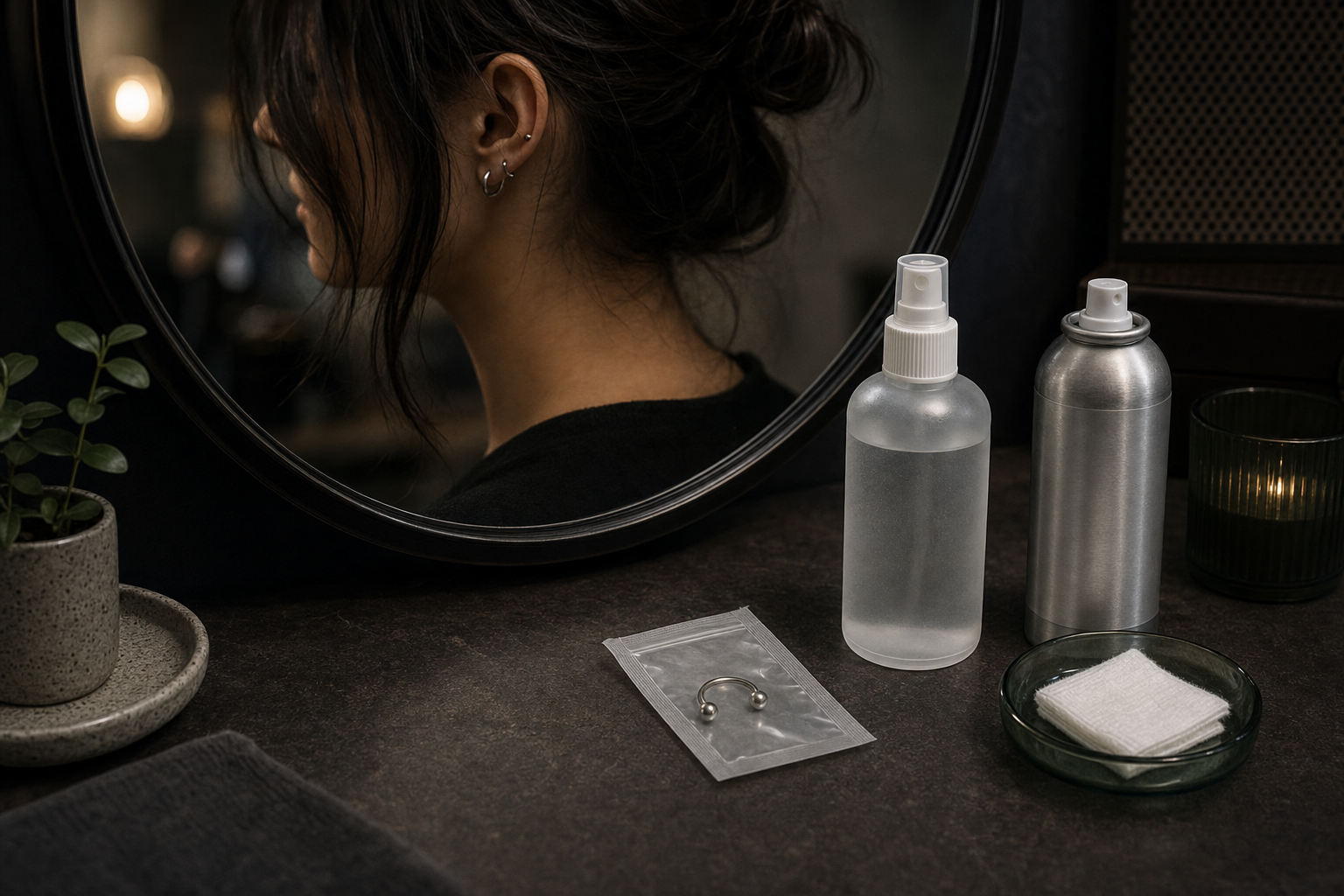
If you have a fresh or irritated piercing and an Octenisept bottle, do not make a cleaning routine from the name on the front. Follow the aftercare instructions from your qualified piercer or clinician, then check the bottle or leaflet for the exact product, ingredients, directions, and warnings.
For general body-piercing aftercare, the Association of Professional Piercers points people toward sterile saline wound wash while healing. Current product records and pages describe Octenisept as an antiseptic product with octenidine and phenoxyethanol, not plain saline.
Check The Bottle First
Octenisept is a product name, so start with the bottle in front of you:
- Which Octenisept product do I have?
- What active ingredients and strengths are listed?
- What body site does the label name?
- Does the label mention wounds, mucous membranes, nose, ears, eyes, swallowing, allergy, children, pregnancy, or open tissue?
- Who told me to use it on this piercing?
An Australian medicine record for an Octenisept spray bottle lists octenidine hydrochloride 1 mg/mL with phenoxyethanol 20 mg/mL. A Schulke product page for octenisept lists octenidine dihydrochloride 0.1 g and 2-phenoxyethanol 2.0 g per 100 g solution. Those examples help identify the product family. They do not replace the label in your hand.
Why This Is Different From Saline
Sterile saline wound wash is usually a simple product: sterile water and 0.9% sodium chloride. The APP says to avoid additives like moisturizers and antibacterials in the saline product used for healing piercings.
Octenisept is not saline. Common examples contain octenidine and phenoxyethanol. Product pages and regulator records can tell you composition and product status, but they do not make the product routine aftercare for every piercing, country, or body site.
Saline And Octenisept: What To Check
| Sterile saline wound wash | Octenisept product | |
|---|---|---|
| What it is | A saline wound-wash product, usually 0.9% sodium chloride. | An octenidine and phenoxyethanol antiseptic product in common examples. |
| Aftercare role | Named in APP general aftercare guidance for healing piercings. | Use it for piercing aftercare only if the exact product label and a qualified person support that use. |
| What to check | Sterile wound-wash label and no additives. | Product name, active ingredients, directions, warnings, country, and body site. |
| What to avoid | Use sterile wound-wash products rather than homemade salt water or contact-lens saline. | Use the exact label and qualified advice rather than the name alone. |
What General Piercing Aftercare Says
For healing body piercings, APP guidance is simple in spirit: wash your hands before touching the piercing, use sterile saline wound wash while healing, dry gently with clean disposable material, and leave the jewelry alone except when cleaning.
The same guidance also warns against over-cleaning, vigorous cleaning, twisting or rotating jewelry, antibacterial soaps, alcohol, hydrogen peroxide, iodine, ointments, and beauty or personal-care products around the piercing while it heals.
That does not mean saline solves every issue. Routine aftercare and problem aftercare are different. If the piercing is fresh, painful, hot, very swollen, draining, changing color, or sitting in cartilage or a mucosal area, ask someone who can look at the piercing and read the product with you.
If Someone Told You To Use Octenisept
Sometimes a piercer, pharmacist, or clinician may mention an antiseptic product because of local availability, a specific piercing, a local label, or a problem they have seen. That is different from finding a bottle online and deciding on your own.
If someone told you to use Octenisept, ask them to tie the advice to the exact product and piercing:
If The Piercing Is Already Irritated
Redness, tenderness, itching, crusting, and mild swelling can happen during healing. Irritation, jewelry pressure, metal sensitivity, infection, trauma, and over-cleaning can also overlap.
An antiseptic label cannot tell whether the jewelry is too tight, the angle is irritated, the site is infected, the material is a problem, or the piercing needs a downsize or medical care. If the piercing is getting worse, ask about the piercing itself, not just what to clean it with.
Good details to share:
- Piercing site: lobe, cartilage, nose, navel, nipple, mouth, genital, surface anchor, or another site.
- Piercing age: days, weeks, months, or healed.
- Jewelry: ring, barbell, flat back, backing, visible swelling room, or jewelry sinking into tissue.
- Symptoms: heat, worsening pain, swelling, drainage, bleeding, fever, chills, itching, rash, strong burning, or spreading color change.
- Products used: saline, Octenisept, soap, cosmetics, hair products, ointment, alcohol, peroxide, iodine, or anything else.
- Label photo: take a clear photo of the front label, active ingredients, directions, warnings, and any batch or country details.
What To Do Now
If you are trying to clean a normal healing piercing, start with the aftercare instructions you were given and sterile saline wound-wash guidance. If you are trying to use Octenisept because the piercing is irritated, painful, swollen, draining, or not healing, that is no longer a simple cleaning question.
Take the exact bottle, the aftercare sheet, or a clear label photo to a qualified piercer, pharmacist, or clinician, along with a clear description of symptoms. If the issue is in or near the mouth, include a dentist or pharmacist. If there has been swallowing, eye contact, or unsafe exposure, use Poison Help or local poison-control guidance.
Common Questions
Common questions
How does Octenisept compare with saline spray?
Sterile saline wound wash is usually 0.9% sodium chloride in sterile water. Octenisept product examples list octenidine and phenoxyethanol, so treat it as an antiseptic product, not plain saline.
Can I use Octenisept instead of saline for a new piercing?
Do not make that swap from the product name. Follow the aftercare advice from your qualified piercer or clinician, and ask before adding an antiseptic to a fresh piercing.
What if my piercer recommended Octenisept?
Ask whether they mean the exact product you have, whether the label matches your piercing site, and what symptoms should change the plan.
Can I use it on a nose, cartilage, mouth, or genital piercing?
Those sites need extra caution. Check the exact label and ask a qualified piercer, clinician, pharmacist, or dentist before using an antiseptic there.
What if Octenisept burns when I use it?
Stop using it until you can ask a qualified person, especially if burning is strong, lasts, or comes with rash, swelling, drainage, or worsening pain.
Should I remove the jewelry if I think the piercing is infected?
Do not force jewelry out or through swollen tissue. If infection, embedding, or trapped jewelry is a concern, ask a clinician or qualified piercer promptly.
What should I send when asking for help?
Send a clear photo of the label, the piercing site if appropriate, the piercing age, jewelry type, symptoms, and every product used on or near it.
What if it got in my eye or was swallowed?
Use the product label's exposure instructions. In the U.S., call Poison Help at 1-800-222-1222. Outside the U.S., use local poison-control or emergency services.
Related Reading
For the broader ingredient-name basics, read What is octenidine?. For product-family names, see What octenidine product names mean. For the difference between antiseptics, disinfectants, antibiotics, and preservatives, read Antiseptic, antibiotic, or disinfectant? What the words mean.